Train Addiction Help Line: 1.866.840.7777
Oct 18, 2013 - Books
Banman Publishing - Works of Art From Canadian Artist Max Jacquiard

Pacific Western Rail System is thrilled to announce a new supplier, Banman Publishing. Banman Publishing is the distributor of the beautiful paintings by Max Jacquiard.

Max Jacquiard has been painting steam trains since 1980. The Coquitlam, B.C. resident has quietly become one of the most respected artists in Canada and North America in his specialized field of portraying steam locomotives.
Max has a sizable library of printed materials, photos and slides of steam trains and the locations and places they would have operated. It is that precise attention to details that sets Max apart from the other artists.
Max has a sizable library of printed materials, photos and slides of steam trains and the locations and places they would have operated. It is that precise attention to details that sets Max apart from the other artists.
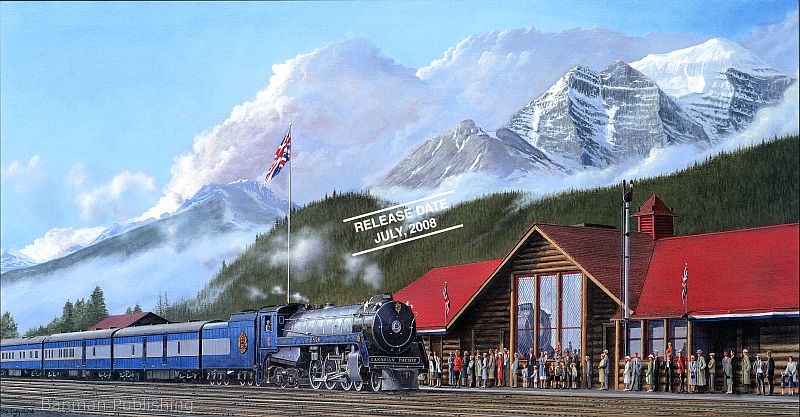
"2850 Royal Train Arriving Lake Louise Station 1939"
The sensitivity and passion that he infuses into his subject is what you feel in each and every one of his canvases. And this is what the Selection Committee of Canadian Railway Hall of Fame must have seen and felt when they selected and induced Max into the 2006 Canadian Railway Hall of Fame.
The evocative nature of Max's paintings has captured the attention and hearts of landscape and steam buffs across Canada and around the world.
His paintings now hang and grace the walls of homes all over the world.
The evocative nature of Max's paintings has captured the attention and hearts of landscape and steam buffs across Canada and around the world.
His paintings now hang and grace the walls of homes all over the world.
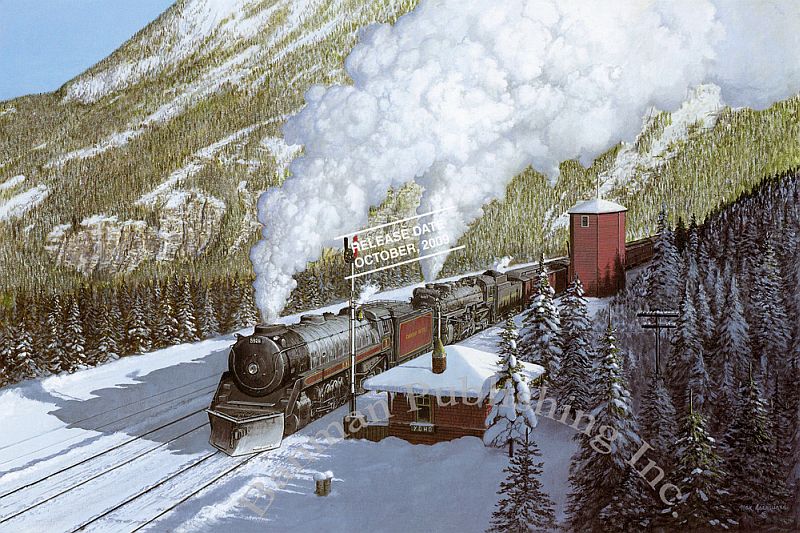
"Easbound at Yohio"
Information You Should Know
There are three different print media:
Canvas Transfer Edition:
A canvas transfer is a print or poster image that has been transferred and fixed to a canvas surface. Unlike a giclée, which is printed onto canvas or paper, this is a chemical process.
Giclée:
Giclée (pronounced zhee-clay) reproductions were originally developed in 1989 as a digital method of fine art printing. The word Giclée is French for "a spray or jet of liquid." The images are scanned and digitally stored in a computer and sent through a designated computer for formatting and alignment then to the high-resolution inkjet printer.
Giclée reproduction is the fastest growing innovation in the fine art market at this time, so say some important voices in the art community. This contemporary technology produces incredible detail and brilliant colours. The actual (versus perceived) image resolution is higher than with traditional lithography, resulting in crisp contrast with rich, intense colours. Artists may enhance and personalize their images by adding finishing touches by hand-painting over the printed image, enhancing or highlighting to produce original mixed media pieces.
Giclée prints are produced on high quality, treated watercolour paper and canvas, similar to what is used by the painter and conditioned for the unique printing process. The media are specially treated to handle the digital inks. They are treated for absorption of the inks producing brilliant, velvety colours. Life-span estimates of prints by third-party tests indicate longevity in excess of 100 years. However, it is recommended that collectors handle these prints as they would watercolour paintings. If the print is on watercolour paper, it is appropriate to protect the paper from moisture under glass. Ordinarily, Giclées produced on canvas are treated with a UV light protecting layer. No print or painting should ever be exposed to direct sunlight.
Giclée prints are produced on high quality, treated watercolour paper and canvas, similar to what is used by the painter and conditioned for the unique printing process. The media are specially treated to handle the digital inks. They are treated for absorption of the inks producing brilliant, velvety colours. Life-span estimates of prints by third-party tests indicate longevity in excess of 100 years. However, it is recommended that collectors handle these prints as they would watercolour paintings. If the print is on watercolour paper, it is appropriate to protect the paper from moisture under glass. Ordinarily, Giclées produced on canvas are treated with a UV light protecting layer. No print or painting should ever be exposed to direct sunlight.
Paper Edition:
There are three different release subsets:
Artist Proof: (is it signed and numbered)
An exclusive subset of any given release, traditionally reserved for use by the artist (and publisher). Collectors give greater value to AP’s, as they are often difficult to obtain. The letters “AP” can be found written beside the numbers, for example 1/20 AP, or A/P. And yes, artist’s proofs are signed as well. All limited editions are
Publisher Proof: (is it signed & numbered)
An exclusive subset of any given release, traditionally reserved for use by the publisher. Collectors give greater value to PP’s, as they are often difficult to obtain. The letters “PP” can be found written beside the numbers, for example 1/20 PP, or P/P
Signed & Numbered:
Each Limited Edition is signed by the artist, certifying his inspection and approval, then numbered. For example 22/90, meaning that this is number 22 out of a total edition of 90


dgs
Product Details


 © 2026 Pacific Western Rail Systems
Train Addiction Help Line: 1 866 840 7777
© 2026 Pacific Western Rail Systems
Train Addiction Help Line: 1 866 840 7777