Train Addiction Help Line: 1.866.840.7777
Dec 26, 2025 - HO Scale
Athearn Genesis - HO Scale - EMD (Electro-Motive Division) FP7 Series Diesel Locomotives



Dear HO Scale Customers;
Athearn Genesis is excited to announce New EMD (Electro-Motive Division) FP7 Series Diesel Locomotives
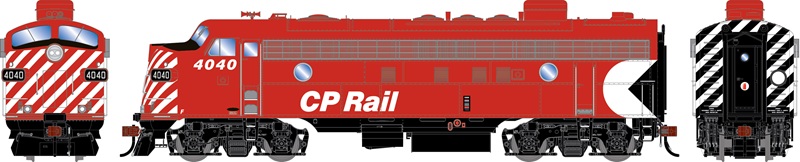
Canadian Pacific
GMD built 35 FP7s for CP. In 1968/69, CP adopted a new brand image in the form of Action Red paint and a large multimark; the FP7s were repainted into this scheme. At first they featured 5” stripes, which was later revised to 8” stripes in the 1970s as depicted by our models.
CP FEATURES:
- Ditch Lights
- Nose door without hinges
- Canadian winterization hatch
- Nathan 3-chime horn
- Sinclair antenna
- Steam generator
- 48” dynamic fan
ROAD NUMBER SPECIFIC FEATURES:
- #4040 Black anti-skid on nose
- #4063 No anti-skid on nose, ladder rest grabs on carbody
†New features including Ditch lights, Canadian winterization hatch, nose door without hinges, and more!

Louisville and Nashville
Built as passenger units, L&N’s diverse fleet of FP7s included units inherited from the CEI, as well as a pair of wreck rebuilds. By the 1960s, most of them were painted in the grey & yellow scheme and were re-geared for freight service.
LN FEATURES:
- RS5T horn
- Steam generator
- Extended MU hoses
- Nose MU receptacle
- Painted-over porthole windows per prototype practice
- Gyralight on nose (flash effect on DCC/sound version)
- Spark arrestors
- “Mushroom” cab vent
- “Whip” antenna

Reading
The year 1950 marked a change in passenger service for the Reading when six FP7’s (#900-#905) began replacing steam powered commuter trains. Originally, the FP7 powered trains used two units coupled back-to-back. This eliminated terminal dwell time, as the A-A configuration did not require the use of a turntable. Despite setbacks to the financial viability of passenger service, in 1967, three units continued to serve the Reading until 1974 when SEPTA (Southeastern Pennsylvania Transit Authority) took over operation of Reading’s passenger trains. Their original Reading paint scheme lasted until 1978, when the units were renumbered by SEPTA.
RDG FEATURES:
- S5T horn
- Steam generator
- Ladder grabs and nose side grabs
- Dual sealed-beam headlight
- Cut skirts
- Warning labels are road number specific

SEPTA
SEPTA (Southeastern Pennsylvania Transit Authority) took over operation of Reading’s passenger trains in 1974. During 1978, the surviving ex-Reading FP7’s were renumbered and shortly thereafter, they were repainted in SEPTA’s red, white, and blue colors. Generally, to an extreme, railfans either loved or hated the new scheme, but all seemed to agree that the new scheme was “eye-catching”. By 1981, SEPTA’s financial troubles ended the use of diesel-powered passenger trains. The units were stored and were later acquired by various historical societies for preservation in the original Reading paint scheme.
SPAX FEATURES:
- Single-note horn
- Ladder grabs and nose side grabs
- Dual sealed-beam headlight
- Sinclair antenna
- Cut skirts
- Steam generator
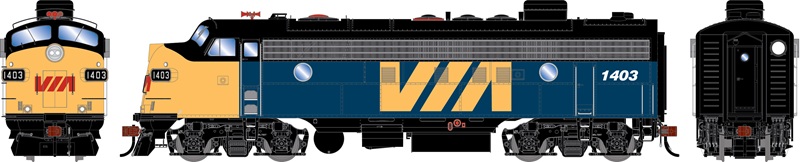
VIA
Via Rail FP units were inherited from CP rail. Some units had replacement components installed which were not necessarily painted to match. The units gave good service, but most were retired by the early 1980s.
VIA FEATURES:
- Ditch Lights
- Nose door without hinges
- Canadian winterization hatch
- Nathan 3-chime horn
- Sinclair antenna
- Steam generator
- 48” dynamic fan
ROAD NUMBER SPECIFIC FEATURES:
- #1403 CP Action Red: Horn, dynamic fan cap, #1 radiator fan base, forward right sand fill is blue.
- #1410 Forward left sand fill is CP action red, ladder rest grabs on carbody
- #1418 Unique scheme with solid blue body sides, ladder rest grabs on carbody
†New features including Ditch lights, Canadian winterization hatch, nose door without hinges, and more!
PROTOTYPE AND BACKGROUND INFO:
EMD F-units were a line of diesel-electric locomotives produced between November 1939 and November 1960 by General Motors Electro-Motive Division and General Motors-Diesel Division. Final assembly for all F-units was at the GM-EMD plant at La Grange, Illinois and the GMDD plant in London, Ontario, Canada. They were sold to railroads throughout the United States, Canada, and Mexico.
The EMD FP7 was a 1,500 horsepower (1,100 kW), B-B passenger-hauling diesel locomotive produced between June 1949 and December 1953 by General Motors’ Electro-Motive Division and General Motors Diesel. Final assembly was at GM-EMD’s La Grange, Illinois plant, excepting locomotives destined for Canada, in which case final assembly was at GMD’s plant in London, Ontario. The locomotive contained an auxiliary water tank and steam generator to supply steam heat to the trailing passenger cars. This necessitated a longer body and frame. Although intended for passenger service, these locomotive still were regularly assigned into freight locomotive pools as well.
F-Unit SERIES LOCOMOTIVE FEATURES:
- Coupler cut levers
- Windshield wipers
- Wire grab irons
- Trainline and MU hoses
- Lift rings
- Sanding lines
- Cab Interior
- Lit signal lights, beacons, and ditchlights, if equipped
- Bell placement & type per prototype
- Detailed Blomberg-B trucks with prototype-specific wheel bearings
- Directional constant lighting
- Headlight brightness remains constant
- Separately-applied photo-etched metal and injection molded detail parts
- Detailed fuel tank with fuel fillers, fuel gauges, breather pipes & retention tanks
- Speed recorder unless noted
- See-through cab windows and full cab interior
- Etched metal fan grilles
- Body-mounted McHenry scale knuckle couplers – Kadee compatible
- DCC-ready features Quick Plug plug-and-play technology with 21-pin NEM connector
- Scaled from prototype resources including drawings, field measurements, photographs, and more
- Accurately painted and printed paint schemes
- Genesis driveline with 5-pole skew wound motor, precision machined flywheels, and multi-link drivetrain
- All-wheel drive with precision gears for smooth & quiet operation
- All-wheel electrical pickup provides reliable current flow
- Wheels with RP25 contours operate on all popular brands of track
- LED Lighting for realistic appearance
- Heavy die-cast frame for greater traction and more pulling power
- Packaging securely holds for the model for safe storage
- Minimum radius: 18” — Recommended radius: 22”
Order Due Date: February 27, 2026
Anticipated Delivery Date: July 2027
Looking for more Athearn (Electro-Motive Division) FP7 Diesel Locomotives? Click here!


Product Details


 © 2026 Pacific Western Rail Systems
Train Addiction Help Line: 1 866 840 7777
© 2026 Pacific Western Rail Systems
Train Addiction Help Line: 1 866 840 7777