
Train Addiction Help Line: 1.866.840.7777
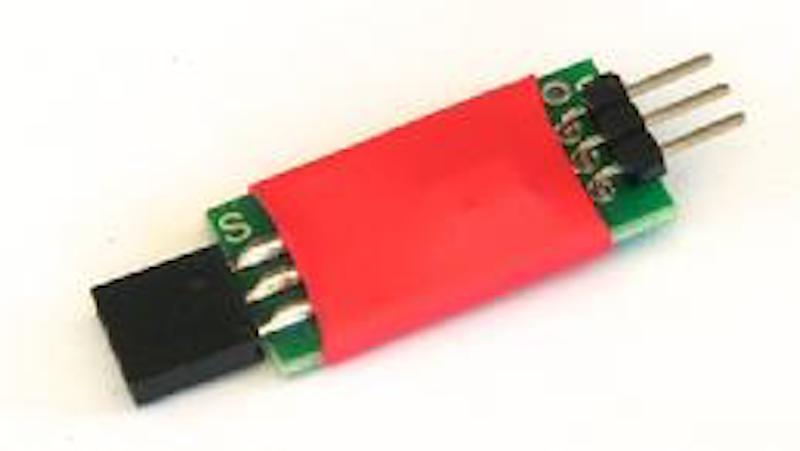
Tam Valley Depot - All Scales - DCC - In-Line Servo Reverser (SKU 7040-SRR001)
Available On: April 1, 2019

The Turtle is stall motor driver designed to run turnouts. It can be used with a number of popular stall motors including the TortoiseTM, SwitchMasterTM, the MP1, MP5, CobaltTM as well just about any 3-12V geared motor. It uses the TVD Fascia Controller for local control and DCC for remote control. It can also be powered with DC if the DCC control is not needed
Uses the Fascia Controller for local control and M-F jumper wires for wiring the motor. Unique features, speed trim pot, fascia controller, 1 Amp drive current (can wire an entire double crossover off of one board), local controller DCC lockout (address+1).
Jumper wires to simplify connections to the boards.
Pre-crimped and shrouded jumper wires in a ranbow of colors. The wires are easily seperated in to singles and bundles just by pulling.

The Male pins fit nicely in to terminal blocks.

The Female jumper wires connect to the gold pin 0.1" headers used on our boards.
You can often reverse your servo throw direction by turning it around or reversing the servo linkage. Sometimes there just isn't room under a turnout to do this. You can't reverse the servo direction by swapping wires since servos work by varying the pulse width and reversing the wires will just disconnect off the servo. In cases where you want to reverse the servo rotation direction, this servo reverser comes in handy. If you put this in line with the servo it will swap the two ends about the center. [It works by mirroring the pulse around 1.5 ms which is the center on a servo. I.e. if a 2 ms pulse is input, the reverser will output 1 ms and if a 1 ms pulse is input it will output a 2ms pulse.]
How to install In-line Reverser and No-Buzz
Install the units as in the picture to the left. The white wires on both sides go to the side marked S (for signal - on some servos this wire is yellow). The right side with the pins go to the servo and the left side with the female plug goes to the board. You can plug the unit directly in to the board or use a servo extension.

$6.95 US
Country of Origin: United States

Something else you might be interested in:

 © 2026 Pacific Western Rail Systems
Train Addiction Help Line: 1 866 840 7777
© 2026 Pacific Western Rail Systems
Train Addiction Help Line: 1 866 840 7777