Train Addiction Help Line: 1.866.840.7777
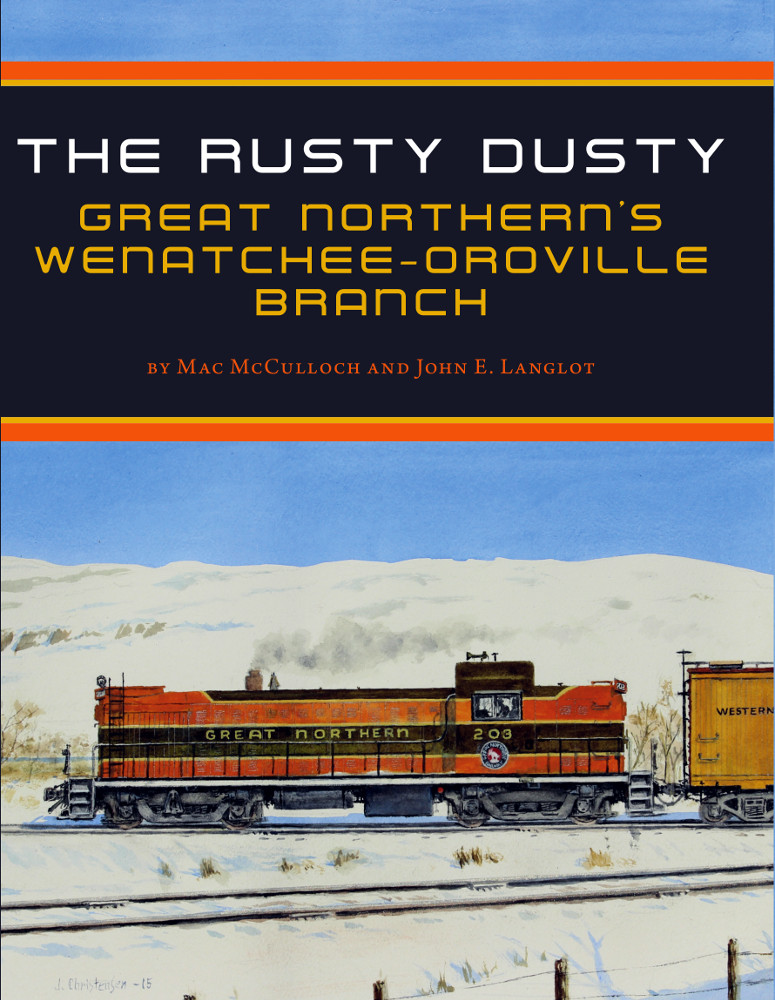
YAKT Publishing - Book - The Rusty Dusty: Great Northern Railway's Wenatchee-Oroville Branch By Mac McCulloch and John E. Langlot (SKU 7915-100)
Available On: September 1, 2016
The Rusty Dusty is a new hard cover book of nearly 400 pages, 70 maps, and 98 photographs that presents a comprehensive look at the Great Northern's Wenatchee-Oroville branch in Washington State. The book is intended for general readers, historians, and rail fans interested in exploring the fascinating history of how GN's westward expansion substantially influenced the history and economy of the Pacific Northwest. For readers interested in the W-O line specifically, it includes construction and operational detail, with numerous maps and photographs that capture the history of this significant line, which enabled and supported the success of the tree fruit industry that literally feeds the nation.
The geographic scope extends from the Canadian Continental Divide and Whitefish, Montana, on the east, to Portland, Seattle, and Vancouver, BC, on the west, with emphasis on the territory between Wenatchee and Oroville. The book explores the relationship of the W–O to subjects and issues seldom included in railroad books such as: the geography and geology of the territory it serves, irrigation to support fruit orchards, refrigerator cars and the Western Fruit Express, freight rates and economic regulation, and the local economy of the area served by the railroad. The local economy is crucial. Any railroad can haul only what people consume or what they produce in such volume that they must sell it beyond the local market.
The Rusty Dusty lays the historical and geographical groundwork for the W-O line beginning with a summary of James J. Hill’s expansion strategy west of Devils Lake, ND. It then describes the construction of the W-O line and the economy of the territory it served. The bulk of the book examines traffic and operations of the W-O under the ownership of the Great Northern, including Wenatchee, Appleyard, ice supply, and the threatened construction of the Wenatchee Southern Railway. Chapter 12 discusses the 1960’s line relocations due to the construction of Rocky Reach and Wells dams, while chapter 13 brings the history of the line up to date.
Authors John Langlot and Mac McCulloch, who combined have more than 50 years of service with Great Northern and its successors, are uniquely qualified to examine and interpret the Great Northern's remarkable history in Eastern Washington. They describe what it was like to work on the Wenatchee–Oroville branch. They tell the working railroad man’s story using materials from long time W–O conductor Orval Dungan and the living memories of co-author John Langlot, who worked the W–O as a brakeman in the 1960s. The authors illustrate the effort and determination of the men who made the Great Northern function, and hope to stand approved by those remaining few who experienced and understand its operations.
The Rusty Dusty's three appendices include special interest details that make this book suitable for the general reader without burdening those with a more extensive railroad background with excessive detail in the running text. The first clearly and in careful detail describes early twentieth-century railroad technology, operational issues, and business practices that underlay W-O operations. The second discusses the refrigerator car fleet of the Great Northern Railway and Western Fruit Express which was crucial to moving the fruit traffic. The final appendix summarizes the physical changes to the line as documented by Authority for Expenditure documents. An extensive bibliography and index are included.
Table of Contents
 Chapter 1 WASHINGTON STATE RAILROADS, 1862-1891
Introduction – The Northern Pacific Charter – Selecting a Puget Sound Terminal – The Panic of 1873 – Reorganization of the Northern Pacific – The Northern Pacific Near Spokane – The Oregon Steam Navigation Company – Henry Villard – The Oregon Railway & Navigation Company – Oregon Railway & Navigation Expansion – Seattle – The Seattle, Lake Shore and Eastern Railway – The Cascade Branch and the OR&N Lease – To the Okanogan Mines – Weakness of the Northern Pacific – Summary
Chapter 2 COMES THE GREAT NORTHERN
Introduction – James J. Hill and the “Manitoba” – Butte, Montana Territory – The Pacific Extension – Finding the Way West –The Head of The Rake – Spokane Before the Great Northern – The Seattle, Lake Shore & Eastern in the Spokane Area – The Spokane Falls and Northern Railway – Great Northern Construction from Montana – The Great Northern comes to Spokane – The Challenge of Stevens Pass – Hill Gains Control of the Northern Pacific – Summary
Chapter 3 BOUNDARY MINING DISTRICT
Introduction – The Kaslo & Slocan – Year of Consolidation – Grand Forks and the Boundary District – The Crows Nest Southern – The Vancouver, Victoria and Eastern to the Coast – The Washington and Great Northern – Summary
Chapter 4 WENATCHEE, WASHINGTON
Introduction – The Development of Wenatchee – A New Transportation Center on the Columbia – Wenatchee Apples – The Eastern Washington Economy in 1905 – Further Irrigation and Development Projects – The Early Refrigerator Car Fleet – The Mansfield Branch – Summary
Chapter 5 PLANNING AND CONSTRUCTION OF THE WENATCHEE – OROVILLE LINE
Construction of the W-O Begins – The Right-of-Way Troubles of 1911 – The Transportation Convention – Right-of-Way Troubles Continue – Construction Resumes – The W-O is Completed – Why did James J. Hill Build to Oroville from Curlew Rather than up the Rivers from Wenatchee? – Why build Between Wenatchee and Oroville? – Summary
Chapter 6 PLACES, STATIONS, PRODUCTS, AND CUSTOMERS
Introduction – Regional Geology and Geography – Wenatchee – Entiat – Chelan – Pateros – Brewster and Bridgeport – Okanogan Valley – Malott – Okanogan – Omak – Riverside – Tonasket – Oroville – Early Railway Facilities at Oroville – Subsequent Changes Prior to Completion of the W-O Line – Developing Traffic by Assisting Customers – Livestock – Dairying – Mining – Wheat – Tree Fruit – Lumber – Canadian Traffic – Inbound Coal – Summary
Chapter 7 EARLY TRAFFIC 1914-1929
Introduction – Freight Traffic – Biles-Coleman Lumber Company – Fruit Traffic – Protective Services – Post-War Fruit Rate Issues – The Western Fruit Express – The WFE’s Hillyard Shops – The Wenatchee Southern Railway – Canadian Traffic – Disposition of Wenatchee Area Development Projects – Summary
Chapter 8 EARLY OPERATIONS 1914-1929
Introduction – The Wenatchee Yard – Appleyard – Train and Engine Crew Assignment – Stations – Water, Fuel and Trackage – Engines – Passenger Service – Freight Service – Track Maintenance Sections, Bridges, and Siding Extensions –Train Service for Perishable Traffic – Summary
Chapter 9 THE GREAT DEPRESSION 1930-1941
Introduction – Passenger Service – Sources of Freight Traffic – Fruit Traffic – Canadian Traffic – Freight Service – Employee Fatalities – Track and Facility Changes – Changes and Expansions at the Wenatchee Terminal – Summary
Chapter 10 STEAM TO DIESEL AND THE END OF PASSENGER SERVICE 1942-1953
Introduction – The Labor Intensive Nature of Railroad Operations – Passenger Service – Sources of Freight Traffic – Fruit Traffic – Canadian Traffic – Freight Service – Freight Engines – The Change from Steam to Diesel – Track and Facility Changes – Changes and Expansions of the Wenatchee Terminal – Summary
Chapter 11 FREIGHT ONLY ERA TRAFFIC AND OPERATION 1953-1970
Introduction – Freight Traffic – Decline of Fruit Traffic – Canadian Traffic and the W-O – Freight Service – Summary
Chapter 12 DAM LINE RELOCATIONS
Introduction – Columbia River Hydroelectric Power – Rocky Reach – Wells – Summary
Chapter 13 A TOUR OF THE WENATCHEE-OROVILLE LINE
Introduction – Operating Plan – A Tour of the W-O – Summary
Chapter 14 POST GREAT NORTHERN TRAFFIC AND OPERATION 1970-2010
Freight Traffic – Fruit Traffic – Canadian Traffic – Freight Service – RailAmerica – Current Freight Traffic – RailAmerica Freight Service – Summary
Appendix 1 – Fundamentals of Railroad Operation in the Early Twentieth Century
Appendix 2 – The Refrigerator Car Fleet
Appendix 3 – W-O Authorities for Expenditure (AFE) by Stations
$64.98 US
Country of Origin: United States

 © 2026 Pacific Western Rail Systems
Train Addiction Help Line: 1 866 840 7777
© 2026 Pacific Western Rail Systems
Train Addiction Help Line: 1 866 840 7777