Train Addiction Help Line: 1.866.840.7777
Walthers - HO Scale - El Capitan Train Set - DCC and Sound with 12 cars and 5 engines - Santa Fe (ATSF) (Red/Silver Warbonnet) (El Capitan Hi-Level Equipment) #40L (DCC and Tsunami Sound) (SKU 920-ElCapitan Set-1)
Available On: May 1, 2012

Based on the 1956 consist with its unique Hi-Level cars, the new HO Scale El Capitan has built-in appeal — and these cars can also be run with Walthers Super Chief, just as the Santa Fe did after 1958!
The El Capitan set of cars and engines is complete with all the cars used on the prototype, including Baggage Car, Railway Post Office, Baggage-Dormitory "transition car" with rooftop shroud, Hi-Level 68-Seat Step-Down Coach, Hi-Level 72-Seat Coach, Hi-Level "Sky Lounge," Hi-Level Diner, and Hi-Level 68-Seat Step-Down Coach with Tail Sign to bring up the rear.
Each car comes fully assembled with Walthers real metal "stainless steel" finish, factory-installed grab irons, prototypically tinted windows, correct trucks and much more.
Typically the El Capitan would consist of 5 F7s in an A-B-B-B-A configuration. This train set has five engines, all DC powered but DCC ready.
Here is information from Wikipedia regarding what a typical train would consist of if you wish to build it up from component parts:
On July 15, 1956 a new, "Hi-Level" streamliner consist debuted:
- EMD F7A Locomotive #327L
- EMD F7B Locomotive #327A
- EMD F7B Locomotive #327B
- EMD F7B Locomotive #44A
- EMD F7A Locomotive #44L
- Baggage #3521
- Baggage-Dormitory "Transition Car" 3480
- Hi-Level "Chair" car (68 Seats) #536
- Hi-Level "Chair" car (72 Seats) #714
- Hi-Level "Chair" car (72 Seats) #722
- Hi-Level Diner (80 seats) #653
- Hi-Level "Top Of The Cap" Lounge (88 seats) #577
- Hi-Level "Chair" car (72 Seats) #700
- Hi-Level "Chair" car (72 Seats) #709
- Hi-Level "Chair" car (72 Seats) #717
- Hi-Level "Chair" car (68 Seats) #529
Santa Fe purchased enough "Hi-Level" equipment to create six complete, nine-car consists. Additionally, six of the railroad's older baggage-dormitory cars had a largely-cosmetic fairing applied to the rear roofline in order to create the distinctive "transition" cars and maintain a streamlined appearance on El Capitan. The dining cars rode on special six-wheel trucks due to their massive weight (all other cars rode on conventional four-wheel trucks). The "Big Domes" were transferred to the Chief pool.
PROTO 2000* Santa Fe 37-Class F7 Diesels
• Prototype Specific Details including:
• Leslie 5-Chime S5T Horn
• 36” Dynamic Brake Fan
• Mars Light
• Vertical FarrType Stainless Steel Grilles
• Real Metal Finish — (Matches Walthers Plated El Capitan & Super Chief Cars)
• Tyically Operated in A-B-B-A Lashups
• Available with Full-Featured Tsunami Sound & DCC Decoder or Standard DC
~~~~~~~~~~~~~~~~~~~~~~~~~~~~~~~~~~~~~~~~~~~~~~~~~~~~~~~~~~~~~~~~~~~~~~~
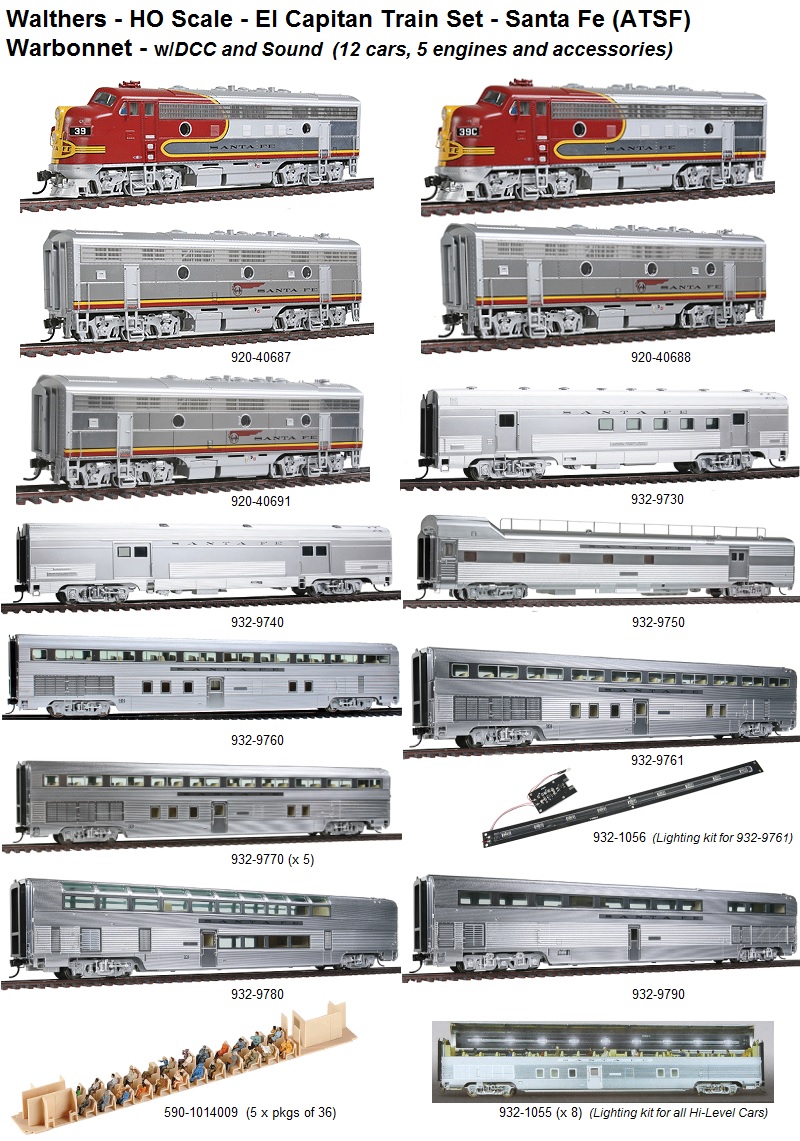
This train set consists of:
920-40687 F7A/B #s 38L and 38A
920-40688 F7A/B #s 38C and 38B
920-40691 F7B # 40A
932-9730 83 foot Railway Post Office
932-9740 73 foot Budd Baggage Car
932-9750 Pullman-Standard 85 foot Baggage-Transition Car
932-9760 85 foot Budd Hi-Level 68 Seat Step Down coach
932-9761 85 foot Budd Hi-Level 68 Seat Step Down coach
932-9770 85 foot Budd 85 foot 72-seat coach x 5
932-9780 85 foot Budd Hi Level Sky Lounge
932-9790 85 foot Budd Hi Level Diner – Santa Fe
590-1014009 Seated passengers 5 x pkgs of 36
932-1055 LED Lighting kit for all Hi-Level Cars x 8
932-1056 LED Lighting kit for 932-9761Santa Fe x 1
~~~~~~~~~~~~~~~~~~~~~~~~~~~~~~~~~~~~~~~~~~~~~~~~~~~~~~~~~~~~~~~~~~~~~~
History:
From Wikipedia, the free encyclopedia

El Capitan was one of the named passenger trains of the Atchison, Topeka and Santa Fe Railway. It was the only coach, or chair car (non-Pullman sleeper) train to operate the Santa Fe main line from Chicago, Illinois to Los Angeles, California on the same fast schedule as the road's premier Pullman Super Chief.
This all-coach, streamlined train (assigned Nos. 21 & 22) began operations in February 1938. Not unlike the Pennsylvania Railroad's Trail Blazer, it offered "low-cost passage with high-speed convenience." Originally conceived as the Economy Chief, the name El Capitan was ultimately chosen to honor the Spanish conquistadors and their influence on Southwestern culture, though it didn't hurt that the name seemed to outrank the Union Pacific's Challenger train, with which it was designed to compete. Unique in charging an extra-fare despite being a coach train, it pioneered such features as "RideMaster" seating optimized for sleeping. The original consists were two new Budd Company-built trains of five cars each made of lightweight stainless steel. Each of the two luxury trains were capable of accommodating 188 passengers; fare Chicago to Los Angeles was $5.00 above the $39.50 regular coach fare (in 1938). The 80-foot cars had 52 seats on 41-1/2 inch centers; postwar 85-foot coaches had 44 seats on 52-inch centers.
El Capitan was the first of Santa Fe's trains to utilize the "Big Dome"-Lounge cars, though these were soon given to the Chief in favor of new double-decker "Hi-Level" coaches developed by Budd and the railroad in 1955. These experimental units featured a quieter ride, increased seating capacities, and boasted better views of the Southwestern terrain El Cap passed through and made this train unique and revolutionary. Amtrak's Superliner equipment, which was placed in service along many of Amtrak's long distance routes, were based on the Santa Fe Hi-Level design. The Superliners were designed to be operated along with older Hi-Level cars.
In 1958 the train was combined with the Super Chief and operated under train numbers 17 and 18 through the end of Santa Fe passenger operations. Today the route formerly covered by El Capitan is served by Amtrak's Southwest Chief. Many of Amtrak's trains (especially those in California) consist of a combination of refurbished former Santa Fe Hi-Level cars along with newer Superliner railcar designs. In recent years, four "mothballed" El Capitan lounge cars were removed from storage, refurbished, and placed into service on Amtrak's Coast Starlight as "Pacific Parlour" first-class lounge cars. These refurbished cars feature a service bar, booths, and chairs on the upper level, and a theater on the lower level.
$2459.75 US
Country of Origin: China
Something else you might be interested in:
 © 2026 Pacific Western Rail Systems
Train Addiction Help Line: 1 866 840 7777
© 2026 Pacific Western Rail Systems
Train Addiction Help Line: 1 866 840 7777