Train Addiction Help Line: 1.866.840.7777
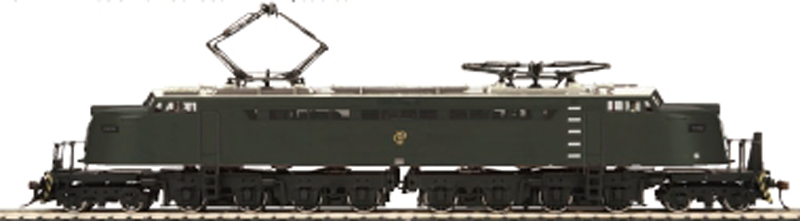
MTH - HO Scale - GE "Little Joe" Electric Locomotive - Brazilian National #6451 (w/DCC & Sound) (SKU 507-802043-1)
Available On: March 1, 2010
By the late 1940s, the engines on the Milwaukee Road's electrified Rocky Mountain Division were nearly three decades old and tired, and diesels were the wave of the future. Management was intending to pull down the overhead wires and dieselize the entire division. Then along came a big electric named Little Joe, and the wires stayed up for another quarter-century.
The Joes were actually built for another customer half a world away, Russia's Trans-Siberian Railroad. But by the time they were ready to deliver in 1948, the Cold War had frozen sales to the Soviet Union, and builder General Electric was stuck with twenty 5,500 hp locomotives designed to run on 3,300 volts DC. As the Milwaukee Road was one of the few American railroads with overhead DC power (at 3,000 volts), GE offered the entire order to the Milwaukee at the fire sale price of one million dollars. At least one unit, painted in GE demo colors, was tested on the Milwaukee in 1948 and acquired the nickname "Little Joe" after Joe Stalin. But the Milwaukee came up with reasons not to make the purchase, and in 1949 three units went to the Chicago, South Shore and South Bend for freight service, where they served until 1983, and five more to Brazil's Paulista Railroad, where they were known as Russas.
An upsurge of traffic from the Korean War convinced the Milwaukee it had made a mistake, and in August 1950 it purchased the remaining 12 Joes for the original million-dollar price. All went to the Rocky Mountain Division between Harlowton, Montana and Avery, Idaho — ten designated EF- 4 for freight service and two as EP-4s for Olympian Hiawatha passenger trains.
Originally the freight units worked in pairs, with a boxcab helper added on the division's tougher grades. But later in the 1950s a GP9 diesel was attached to the Little Joe pairs and controlled from the lead Joe; this combination could run straight through electrified territory without adding or dropping helpers. By the following decade, Joes were simply cut in ahead of the freight diesels at the beginning of electrified territory, with the Joe's engineer controlling all units. Eventually, however, second-generation diesels brought an end to electrification, and on June 15, 1974, the last Little Joes folded their pantographs.
New for 2010, the M.T.H. Little Joe duplicates the brute strength and dependability of the original, complete with a detailed die-cast metal body and, for the first time in HO, operating pantographs that raise and lower automatically according to the direction of travel.
FEATURES:
• Die-Cast Metal Body
• Die-Cast Metal Chassis
• Authentic Paint Scheme & Cab Numbers
• RP-25 Metal Wheels Mounted On Metal Axles
• Constant Voltage, Directiona Headlights
• Prototypical Rule 17 Lighting
• Remotely Controlled, Directionally Activated Operating Pantographs
• Detailed Truck Sides
• Detailed Cab Interior
• Powerful 12-Volt 5-Pole Precision Skew-Wound Flywheel-Equipped Motor
• (2) Scale Kadee-Compatible Remotely Controlled Proto-Couplers
• (2) User-Installable Kadee-Compatible Magnetic Couplers
• Metal Handrails and Bell
• Metal Horn
• Locomotive Speed Control In Scale MPH Increments
• Interchangeable Traction Tire-Equipped Drive Wheels
• On-Board DCC Receiver
• Operates On Code 70, 83, & 100 Rail
• Proto-Sound® 3.0 With The Digital Command System Featuring Passenger Station or Freight Yard Proto-Effects™
• Unit Measures: 12 3/4" x 1 3/8" x 2 7/16"
• Operates On 18" Radius Curves
$399.95 US
Country of Origin: China
Something else you might be interested in:
 © 2026 Pacific Western Rail Systems
Train Addiction Help Line: 1 866 840 7777
© 2026 Pacific Western Rail Systems
Train Addiction Help Line: 1 866 840 7777