Train Addiction Help Line: 1.866.840.7777
May 19, 2014 - HO Scale
ORDER DEADLINE ALERT - Athearn Genesis HO Scale GP7u Topeka Cab Locos
You must place an order for any of these products NOW if you want
GUARANTEED DELIVERY

PROTOTYPE
By the 1970s, the Atchison, Topeka & Santa Fe Railway was facing the same problem many owners of large fleets of 1950s-vintage GP7 and GP9 locomotives was facing; what to do with locomotives approaching their 15th or even 20th birthdays, and long since eclipsed by higher-horsepower, newer-technology machines. While no longer as useful on increasingly heavier over-the-road trains due to their lower horsepower and tractive effort, they could still be of use in switching and local duty. However, their as-built high short hoods and aging cab appliances would be a liability, not to mention their declining reliability from years of hard service.
Like some other railroads did during that era, such as Illinois Central and Southern Pacific, Santa Fe decided to cycle their GP7 and GP9 units through an in-house rebuild program in their Cleburne, Texas shops. In November 1972, the first units would be released, sporting "chopped" short hoods for improved visibility, and a host of internal improvements and upgrades. Interestingly, these first few rebuilds retained their round-roof cabs, before the railroad would switch to an angled-roof version, nicknamed "Topeka" cabs, whose design, according to railfan lore, originated at Santa Fe’s Topeka, Kansas shops.
Sporting the unofficial designation of GP7u and GP9u by railfans (the "u" indicating "upgraded"), hundreds would be released from Cleburne’s shops, serving all over the vast Santa Fe system in a variety of roles. Visually distinctive thanks to their unique cab roofline...markedly different from contemporary EMD cabs of the time...with a few changes to the design here and there, such as revisions to the numberboard housing, the design would evolve into one of the most ubiquitous faces on the Santa Fe railroad of the 1970s through the 1990s. Although none remain on today’s BNSF roster, many continue to serve to this day with shortline and industrial railroads...testimony to the longevity of Santa Fe’s rebuild effort.
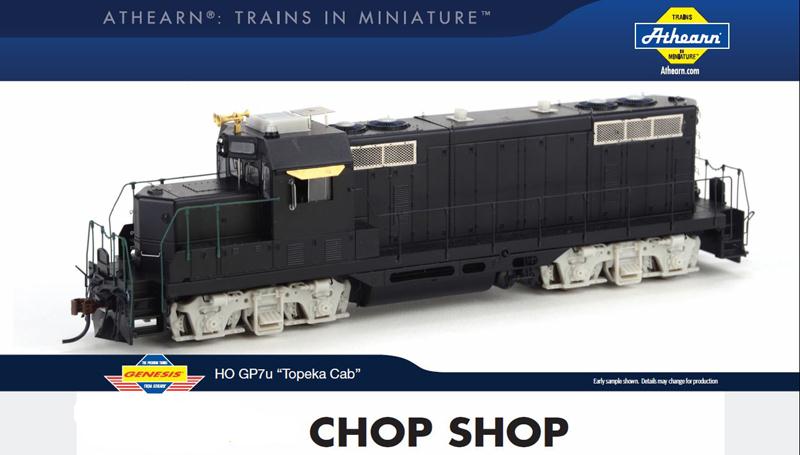
In continuing with the extremely popular Athearn Genesis GP7/9 series of locomotives, we are pleased to introduce the Athearn Genesis GP7u and GP9u family of locomotives. Based upon later rebuilds with angled cabs and revised number board housings, these represent what to many are the "quintessential" GP7u and GP9u Topeka Cab rebuilds. As you’ve come to expect from Athearn Genesis, many, many detail variations will be done per roadnumber and era, including different GP7u and GP9u carbody phases (Phase I, II, etc.), exhaust stacks, horns, cab step boxes, radio antennas, beacons, "blanked" dynamic brake housings, sidesill fuel tank skirts, and more. Featuring the proven Athearn Genesis GP7/9 mechanism, these smooth-running models will be DCC-ready in analog, and will also be available with optional DCC and SoundTraxx Tsunami sound.
Reservation Due By: May 22, 2014
Expected Release: January 2015


reb
Product Details


 © 2026 Pacific Western Rail Systems
Train Addiction Help Line: 1 866 840 7777
© 2026 Pacific Western Rail Systems
Train Addiction Help Line: 1 866 840 7777