Train Addiction Help Line: 1.866.840.7777
Dec 24, 2011 - HO Scale
ORDER DEADLINE ALERT - MTH Signature Series HO Scale UP SD70ACe & 4500hp Gas Turbines
You must place an order for any of these products NOW if you want
GUARANTEED DELIVERY


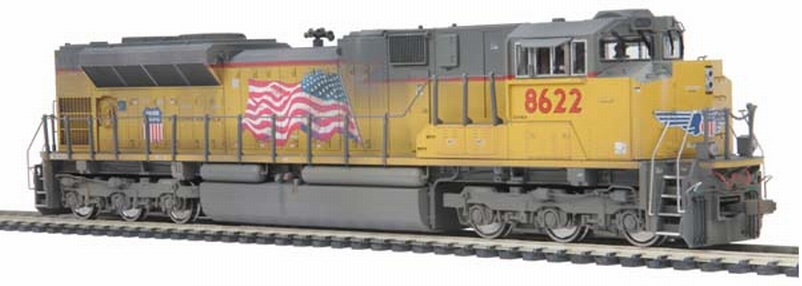
Union Pacific SD70ACe Diesel Engine w/Proto-Sound 3.0 (Comfort Cab)
The SD70ACe is Electro-Motive Diesel’s hope for the future. While designed to meet the Environmental Protection Agency’s Tier-2 emissions requirements that took effect on January 1, 2005, this replacement for the SD70MAC also has a higher purpose: to recapture the lead in North American locomotive sales that EMD lost to General Electric in 1987.
Under the hood beats a third-generation model 710 diesel with 4300 horsepower; only slight modifications were needed to make the existing model 710 meet new emission standards. With 5000 such motors in service worldwide and a reputation for dependability, EMD reasoned that shop crews would prefer familiar technology.
Other than the prime mover, however, virtually every element of the SD70ACe has been re-thought to create a 21st century locomotive. Ergonomics were a prime consideration. The engine’s angular nose offers the crew far better visibility than most other locomotives, and the cab is comfortable for engineers of almost any size. Digital screens provide a range of information on what is happening both inside the locomotive and out on the road. The cab easily accommodates a crew of three — an important factor in a modern world without cabooses. And there is, of course, a cupholder for the engineer.
The SD70ACe also offers, in EMD’s words, “outstanding improvements in maintainability.” All electrical wires are on the right side of the locomotive and all piping is on the left, with most pipes and wires routed under the frame so they can be serviced by a man standing outside the engine — rather than crawling around at the bottom of the engine room. And the time between service intervals has been doubled, from every three months to every six months.
After a year of testing on the road and at the Association of American Railroads’ test track in Pueblo, CO, the first SD70ACe’s (‘e” stands for “enhanced”) were delivered to CSX Transportation in 2004. Today they are rostered by nearly every North American Class 1 railroad. At the present time, mainline American railroads generally maintain dual fleets of locomotives. AC power is used for heavy coal hauling and hotshot intermodal traffic because AC traction motors offer higher starting tractive effort with the same horsepower. Less expensive, traditional DC power is used for more mundane duties. But with the SD70ACe, Electro-Motive hopes it may have the 21st Century successor to its 1949 Geep — a locomotive that can be nearly all things to all railroads.

* * * * *

Union Pacific 4500hp Gas Turbine With Proto-Sound 3.0
MTH is proud to introduce the UP "Baby" 4500 turbine locomotives, with all the same detailing and features of its bigger brother, the Veranda. Variable intensity smoke, a broad range of sounds, turbine crew conversations, remotely controlled couplers, operating Mars light, built in DCC decoder, and die-cast metal construction, twin flywheel-equipped motors, and four traction tires to provide pulling power all cumulate in a model that rivals the prototype.
In the late 1940s, even as it was building diesels in partnership with Alco, General Electric was experimenting with ways to apply its aircraft jet engine technology to railroading. Its gas turbine electric (GTEL) was basically a diesel engine with a large turbine replacing the diesel as the prime mover. In a turbine, intake air is compressed by spinning turbine blades and fed into combustion chambers, where fuel is added and ignited, as in a jet engine. The hot exhaust gases spin the blades of another turbine that powers one or more generators, which produce electricity to power diesel-type traction motors. Compared with diesels of the period, GE's GTEL put three times as much power (4500hp) in one locomotive, had significantly fewer moving parts, and did not vibrate like a diesel. The major drawback was a voracious appetite for fuel.
Undeterred by the failure of its steam turbine prototypes, GE perused the development of a gas turbine engine, and in June of 1949 UP added the prototype to their roster for further testing. Locomotives #51-60 were then ordered by UP in March of 1951. In their first year of operation the locomotives averaged approximately 4.2 gallons of total fuel per 1,000 gross ton-miles. Union Pacific's president A.E.(Art) Stoddard referred to the locomotives as "jet propulsion on wheels", claiming the turbine gas engines "might well revolutionize American railroading". The Baby's 4500hp turbines demonstrated the locomotives ability to go faster then diesel engines and appeared, at the time, to be the more economical choice.
While not intended for passenger use, on occasion the gas turbine 4500 locomotive pulled in a streamlined passenger train after a diesel engine would break down. Although the locomotive was not designed for multiple unit operation, they were occasionally double loaded, even through long tunnel routes where recalculation of exhaust gasses could pose problems. After two years of testing GE's prototype, the Union Pacific ordered its first ten GTELs in 1951. The engines were designed to burn Bunker C oil, a byproduct of petroleum distillation that was almost considered waste material. The low cost of Bunker C more than compensated for the turbines' high consumption, although the oil was so thick it had to be heated to 240 degrees Fahrenheit to flow though the fuel system. In 1955 auxiliary fuel tenders were added to the locomotives, this additionally 24,000 gallons of oil allowed the train to make longer runs, increasing monthly mileage.
Averaging around 10,000 miles a month (400 turbine operating hours), the locomotive also contained a 250hp diesel engine, which was used to bring the turbine engine up to its firing speed of 700RPM. This allowed the engine to then run fans, pumps, cooling motors, auxiliaries, and allowed the locomotive to move around terminals when running light. Unfortunately, by the early 1960s, the turbines' use of Bunker C fuel had changed from an advantage to a problem. The plastics industry had found new uses for the former waste product and its price skyrocketed. At the same time, the corrosive nature of the fuel led many of the turbines to develop engine problems. The Verandas were retired in 1963-64 in favor of newer 8500hp Big Blows, and the UP's entire turbine program was finished by 1970.

* * * * *
Signature Series models feature professionally weathered finishes by a master modeler with more than 30 years of modeling experience. The resulting finish ensures that these new Signature Series models will look right at home on any fully sceniced and weathered layout.
- All models will be airbrushed weathered, using special proprietary techniques designed to capture subtle natural processes that show details previously only obtainable using chalks and pinpoint washes.
- No two finishes will look exactly alike so that you may have numerous models of the same engine, each with its own unique finish. All models will be flat sealed to allow handling and use of smoke fluid.
-
These unique offerings provide a level of customization never before offered by a major model railroad manufacturer and are an excellent solution for those who have either not had the confidence to attempt weathering techniques or simply don't have the time to do it themselves. Most importantly, these professionally weathered models can withstand the rigors of operation while mimicing the real-life look needed to recreate a world class model railroad.
ORDER BEFORE DECEMBER 27 FOR DELIVERY IN MARCH 2012

jkb
Product Details


 © 2026 Pacific Western Rail Systems
Train Addiction Help Line: 1 866 840 7777
© 2026 Pacific Western Rail Systems
Train Addiction Help Line: 1 866 840 7777