Train Addiction Help Line: 1.866.840.7777
Apr 26, 2010 - HO Scale
ORDER DEADLINE ALERT - Intermountain Announces Canadian 1967 Centennial Engines FP9 1967 and FP9 186
You must place an order for any of these products NOW if you want GUARANTEED DELIVERY.


Dear HO Scale Customers:
What would the "Confederation Train" be
with out the proper sound?
Many of you may not be aware, but these engines actually had two sets of horns! A second set was added to play the first four notes of O Canada. It turns out that, one of our good customers had a very high quality recording of the actual air horn with the distinctive four notes. We passed this on to Intermountain who inturn asked Soundtraxx asking if the sound could be incorporated into the decoder chip. We have had a number of requests from customers as to why Intermountain didn't include this feature on the HO Scale engines. Well here is the e mail we just received from Intermountain:
Hi Pacific Western Rail:
SoundTraxx has programmed the O-Can-A-Da horn sound for our FP9 circuit board. We will be receiving a sample next week. The Canada Confederation Train units will have the right sound.
The reservation period for the Confederation units will end to April 30. We (Intermountain) plan to print a message in the IRC April dealer reservation request, announcing that the model will have the accurate sound. Note the board will also have the three chime horn sound as an alternate.
Regards,
Larry, Intermountain
Here is the sound that will be on board.
One other note you should be aware of, this new run of FP9s by Intermountain will come equipped with Tsunami Sound from Soundtrax.
Intermountain has announced a very important set of engines in this release, that should be of interest to all of our customers who model Canadian Trains. In 1967 Canadian Pacifc and Canadian National painted up engines and passenger cars for the creation of a special Centennial Confederation Train to tour Canada.
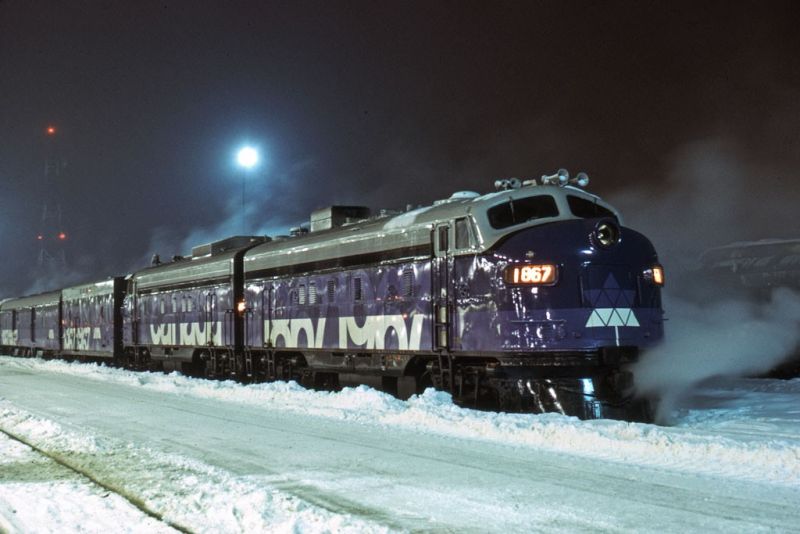
Photo by Jim Brown
On New Year’s Day morning 1967, hours after Prime Minister Lester B. Pearson had lit the Centennial Flame on Parliament Hill at midnight to launch the nationwide observance of the 100th anniversary of Canada's nationhood, a ceremony was held at the new Ottawa Station. Madame Pauline Vanier, on behalf of her husband Governor General Georges Vanier, dedicated the train to reacquaint Canadians with their history during that momentous year of celebrations.
The train included a diesel locomotive and eight coaches coaches loaned by Canadian National Railway. The exterior facades of the coaches were walled over and given a colourful "super graphics" treatment. The diesel had the Centennial symbol emblazoned on its nose under the headlight and the locomotive horn sounded the first four notes of O Canada. The train made its public debut in Victoria on January 9. It crossed the nation, arriving at the Atlantic coast in Nova Scotia by October and ended its itinerary in Montreal on December 5.
Over the intervening months, some 60 cities and towns, and hundreds of thousands of Canadians, visited the train. The Confederation Train was funded by the Government of Canada through the Centennial Commission. It operated under the jurisdiction of the Secretary of State. The project was designed and coordinated by the Canadian Government Exhibition Commission, an agency of the then Department of Trade and Commerce.
About the Conferedation Train
Canada's early growth and indeed her very existence as a nation following Confederation depended on the construction of rail lines to link the provinces and to span the continent. It is fitting, therefore, that the Confederation Train should traverse the country in 1967 to remind Canadians of this historical fact.
But the Confederation Train is no ordinary train. It is a train of adventure; a moving panorama of Canada from pre-historic times through Confederation to the present.
For the hundreds of thousands of Canadians and their guests who will visit the train as it stops across the country during 1967, it will be a lasting experience. They will come to know what it was like in Canada after the ice age lefts its indelible mark upon the land. They will come face to face with the realities experienced by the first settlers and explorers. They will be able to pause and reflect upon the meaning and significance of Confederation itself in the chamber devoted to this memorable event.
The visitor to the train will feel what it was like to take steerage passage to Canada from Europe as so many Canadian immigrants did. He will be surrounded by the atmosphere experienced by the Canadian soldier in the First World War. He will be taken dramatically through the boom and bust of the twenties and re-live the atmosphere of the hungry thirties.
How can all this possibly happen within the confines of six specially designed railway cars? That is the surprise that awaits each visitor as he passes to enter the train. It is a surprise that must be experienced.
The Confederation Train will make exhibition stops in most of Canada's major cities and towns. It will begin on the west cost at Victoria, B.C., on January 9th and move eastward until it reaches the Maritimes on October 26th. Then it will swing back into Québec for a four-city tour before completing its itinerary in Montréal.
Now for the importat part of this message: We can think of no reason why a modeler would want one engine. They ran as a pair! So just like you would never just buy the left shoe without the right shoe, please make sure if you want both engines, make sure you order "2" when placing your order!
A numnber of customers have been ordering tonight, thinking by ordering "1" they will get both engines.
And a number of customers have commented "they would have ordered them both if they new a little about the history surrounding these two important engines".
Remember the road numbers are 1867 and 1967, Canada's Years of 100 years of Confederation.
Yes we will be talking to Rapido in the morning about doing some of the cars.
What Was The Canadian Centennial?
The Canadian Centennial was a year long celebration held in 1967 when Canada celebrated the 100th anniversary of the Canadian Confederation. Celebrations occurred throughout the year but culminated on Dominion Day, July 1.
Communities and organizations across Canada were encouraged to engage in "Centennial projects" to celebrate the anniversary. The projects ranged from special one-time events to local improvement projects, such as the construction of municipal arenas and parks. A Centennial Train traversed the country and school children across the country were able to see exhibits raising their consciousness as to Canadian history and nationalism and enlivening their enthusiasm to visit Expo.
Children born in 1967 were declared "Centennial babies", one of which was future model and actress Pamela Anderson, born on July 1 (Canada Day).
But the Confederation Train is no ordinary train. It is a train of adventure; a moving panorama of Canada from pre-historic times through Confederation to the present.
For the hundreds of thousands of Canadians and their guests who will visit the train as it stops across the country during 1967, it will be a lasting experience. They will come to know what it was like in Canada after the ice age lefts its indelible mark upon the land. They will come face to face with the realities experienced by the first settlers and explorers. They will be able to pause and reflect upon the meaning and significance of Confederation itself in the chamber devoted to this memorable event.
The visitor to the train will feel what it was like to take steerage passage to Canada from Europe as so many Canadian immigrants did. He will be surrounded by the atmosphere experienced by the Canadian soldier in the First World War. He will be taken dramatically through the boom and bust of the twenties and re-live the atmosphere of the hungry thirties.
How can all this possibly happen within the confines of six specially designed railway cars? That is the surprise that awaits each visitor as he passes to enter the train. It is a surprise that must be experienced.
The Confederation Train will make exhibition stops in most of Canada's major cities and towns. It will begin on the west cost at Victoria, B.C., on January 9th and move eastward until it reaches the Maritimes on October 26th. Then it will swing back into Québec for a four-city tour before completing its itinerary in Montréal.
Now for the importat part of this message: We can think of no reason why a modeler would want one engine. They ran as a pair! So just like you would never just buy the left shoe without the right shoe, please make sure if you want both engines, make sure you order "2" when placing your order!
A numnber of customers have been ordering tonight, thinking by ordering "1" they will get both engines.
And a number of customers have commented "they would have ordered them both if they new a little about the history surrounding these two important engines".
Remember the road numbers are 1867 and 1967, Canada's Years of 100 years of Confederation.
Yes we will be talking to Rapido in the morning about doing some of the cars.
What Was The Canadian Centennial?
The Canadian Centennial was a year long celebration held in 1967 when Canada celebrated the 100th anniversary of the Canadian Confederation. Celebrations occurred throughout the year but culminated on Dominion Day, July 1.
Communities and organizations across Canada were encouraged to engage in "Centennial projects" to celebrate the anniversary. The projects ranged from special one-time events to local improvement projects, such as the construction of municipal arenas and parks. A Centennial Train traversed the country and school children across the country were able to see exhibits raising their consciousness as to Canadian history and nationalism and enlivening their enthusiasm to visit Expo.
Children born in 1967 were declared "Centennial babies", one of which was future model and actress Pamela Anderson, born on July 1 (Canada Day).
The Confederation Train
Equipment:
The Confederation Train of 1967 included 15 individual pieces of equipment, including locomotives and all cars. The list below is a description of each piece and numbered as to it’s most commonly seen position in the train (from front to back).
1. Confederation FP9A locomotive # 1867 (CPR # 1411)
2. Confederation FP9A locomotive # 1967 (CNR # 6509)
3. Steam Generator Car (CNR # 15463)
4. 85’ Baggage Express Car (CPR # 4224)
5. Lightweight Sleeping Car (CPR - "Oak Grove")
6. Dining Car (CNR # 1303)
7. Lightweight Sleeping Car (CPR - "Ash Grove")
8. Lightweight Sleeping Car (CPR - "Fir Grove")
9. 85’ Electrical Generator Car (CPR # 4731 rebuilt from baggage express car)
10. Display Car - First Class Coach (CPR # 2298)
11. Display Car - First Class Coach (CPR # 2285)
12. Display Car - First Class Coach (CPR # 2266)
13. Display Car - First Class Coach (CPR # 2258)
14. Display Car - First Class Coach (CPR # 2240)
15. Display Car - First Class Coach (CPR # 2236)
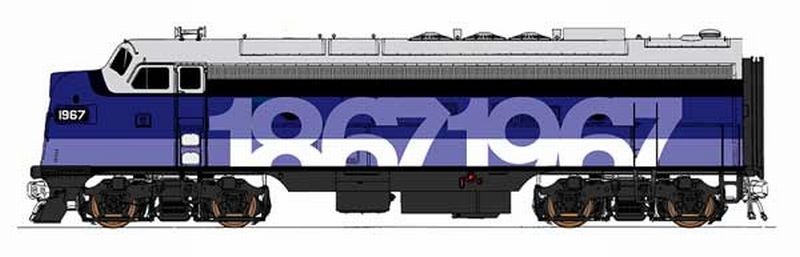
Model Features:
► Sharp Painting and Lettering
► Multiple Road Numbers
► Wire Grab Irons
► Etched Metal Details
► Equipped with Kadee Couplers
The smooth drive is available either as DCC ready with the 8-pin NMRA compatible socket on the PC board or with a QSI sound system that will operate on either DC or DCC.
Reservations Due by April 29, 2010
Expected Delivery in December 2010
jch
Product Details


 © 2026 Pacific Western Rail Systems
Train Addiction Help Line: 1 866 840 7777
© 2026 Pacific Western Rail Systems
Train Addiction Help Line: 1 866 840 7777