Train Addiction Help Line: 1.866.840.7777
Jan 1, 2018 - Periodical News
Saskatchewan Potash Producers, Canpotex, and the Global Export System


Saskatchewan Potash Producers, Canpotex, and the Global Export System
The Saskatchewan potash industry is built around a small number of major producers, but its global reach depends on a shared export structure that is unique in the rail and fertilizer world. At the center of this system is Canpotex, a joint marketing and export company that coordinates the overseas shipment of potash produced in Saskatchewan. Rather than each producer independently managing export logistics, Canpotex consolidates product, rail movement, and ocean shipping into a unified supply chain designed for efficiency and global market stability.
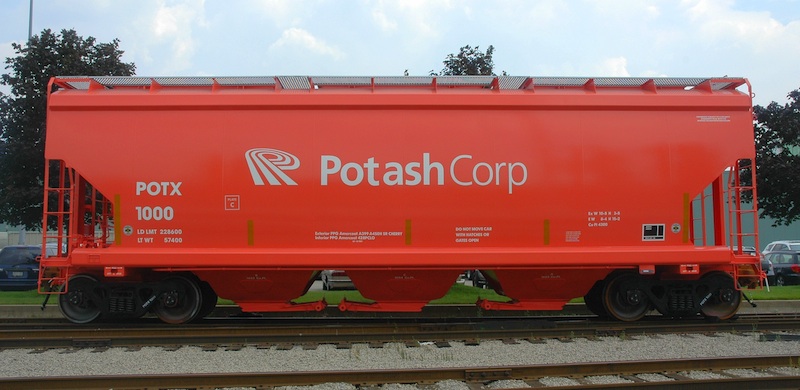
Historically, two of the key companies behind this system were Potash Corporation of Saskatchewan (often known as PotashCorp) and Agrium. Both were major integrated fertilizer and agricultural input companies with significant potash production capacity in Saskatchewan. PotashCorp operated large-scale mining and processing facilities, while Agrium was a diversified agricultural input company with fertilizer production and retail distribution assets.
 |
 |
In 2018, these two companies merged to form Nutrien, creating one of the largest agricultural input companies in the world. Nutrien inherited the combined potash production capacity, distribution infrastructure, and global market position of both predecessor companies, including their participation in Canpotex as a major shareholder and producer.
As a result, what had previously been three major Saskatchewan potash producers participating in the Canpotex system - PotashCorp, Agrium, and Mosaic - effectively became two principal producing companies: Nutrien and Mosaic. This consolidation simplified the ownership structure while maintaining Saskatchewan's dominant position in global potash exports.
Alongside Nutrien, another key participant in Saskatchewan potash production is The Mosaic Company. Mosaic operates large potash mining and processing facilities in Saskatchewan, including operations at Esterhazy and Belle Plaine, and is one of the largest individual potash producers globally. Like Nutrien, Mosaic is deeply integrated into the province’s rail-based export system.
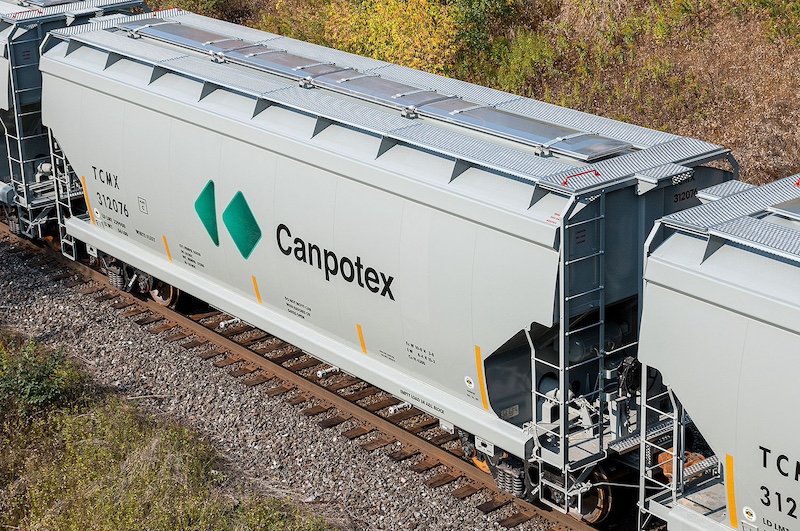
Together, Nutrien and Mosaic are the owners and principal participants in Canpotex. Canpotex itself functions as the coordinated marketing and logistics arm for offshore potash sales, managing contracts, vessel loading, and export routing on behalf of its owners.
From a rail perspective, this structure is critical. Saskatchewan potash moves almost entirely by rail from mine sites to export terminals on the West Coast, primarily through networks operated by Canadian Class I railways. Dedicated unit trains of covered hopper cars - often in the distinctive Canpotex pool fleets - move product from mines in the Lanigan, Cory, Allan, Colonsay, and Esterhazy regions toward terminal facilities in British Columbia. At the coast, Canpotex coordinates ship loading for delivery into international markets.
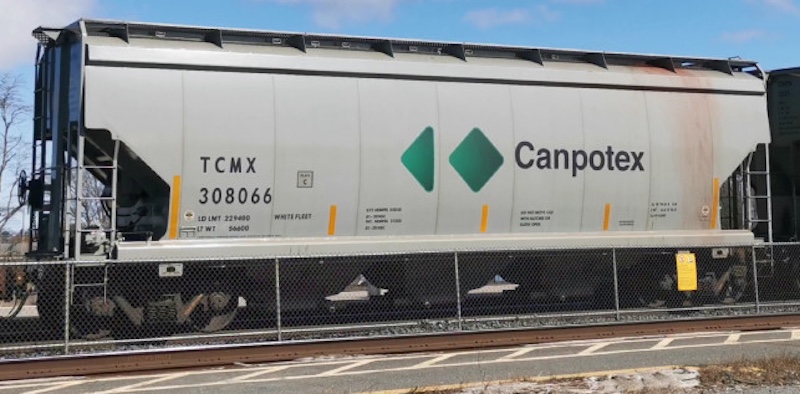
This integrated system - mine, rail, terminal, and ocean shipping - has made Saskatchewan one of the most important global sources of potash, a key input for agricultural fertilizer production worldwide. The scale and consistency of this movement is what drives the specialized equipment pools and unit train operations that modelers often see replicated in modern railroading.
Canpotex itself operates as a non-producer logistics and marketing organization, meaning it does not mine potash directly. Instead, it serves as the export coordination layer between producers (Nutrien and Mosaic) and global customers, ensuring steady supply flow and optimized rail and marine logistics.
For rail operations, this system represents one of the most consistent and high-volume bulk commodity flows in North America - unit trains of potash moving from inland mines to tidewater ports, operating year-round across prairie and mountain subdivisions.


 © 2026 Pacific Western Rail Systems
Train Addiction Help Line: 1 866 840 7777
© 2026 Pacific Western Rail Systems
Train Addiction Help Line: 1 866 840 7777