Train Addiction Help Line: 1.866.840.7777
Jul 11, 2021 - HO Scale
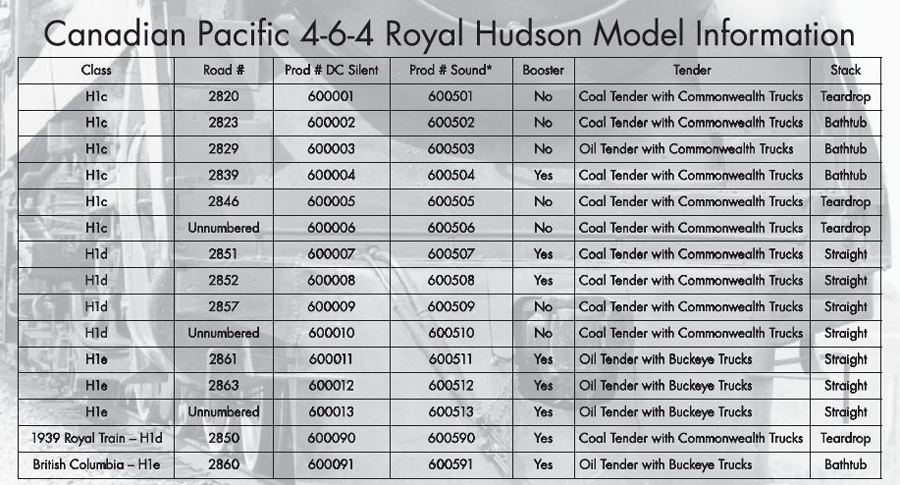
Rapido Trains - HO Scale - 4-6-4 Royal Hudson w/Sound & DCC Canadian Pacific Railway 1939 Royal Train Scheme


Dear HO Scale Customers;
One of our customers recently passed away, they paid for the Royal Hudson 1939 Royal Train Scheme, never got a chance to run it, and will need to find the set a new home.
We do not sell used products, however, if you are interested in buying the Royal Hudson 1939 Royal Train Scheme, and are a serious buyer, please email Hannah directly at [email protected]

We found a cool history on the The 1939 Canadian Royal Tour / Royal Train! Sink your teeth into this and learn about why this specific locomotive is so iconic in the history of Canada!

The 1939 Canadian Royal Tour / Royal Train
War was looming. Few in Britain doubted it would come. It was a good time to make clear who your friends were...
What was to be known as the Royal Tour of Canada was, in actuality, a thinly veiled dispatch of King George VI and his bride Queen Elizabeth to bolster support for Britain in the New World.
And it worked.
In the spring of 1939, a tour of The Dominion was planned that would take a reigning British monarch to North America for the first time ever. To the public, it was an official state visit the likes of which Canada had never seen. For an entire month the King and Queen traveled virtually nonstop, visiting dozens of communities and giving dozens of speeches on a whirlwind coast-to-coast whistle-stop tour of Canada and the US. Their message of goodwill and solidarity was repeated in towns large and small. And the public loved it, turning out in droves to catch even a glimpse of the immensely popular royal couple.
Behind the scenes, the tour was a chance for the British government to make it clear just how important Canada and the US were to them. The message was clear: You are our friends. And we may soon need your strength.
But the message wouldn't have gotten out without a train. And to that end, only a Royal Train would do.
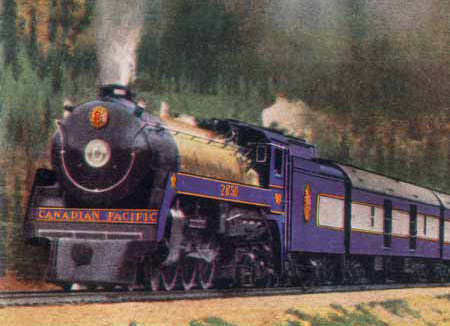
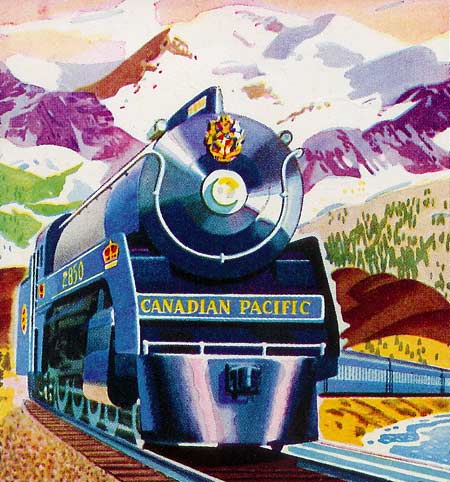
Competitors Canadian National Railway and Canadian Pacific Railway sought to outdo each other in preparation of a train for the ages. Each supplied half the cars. Westbound, the Canadian Pacific would handle the train -- offering up their best performing locomotive for the job. Decked out in royal blue and silver livery to match the 12-car train, Hudson 2850 would set an endurance record for a single steam locomotive, traveling over 3200 miles without replacement or breakdown.
On the eastbound leg, Canadian National enlisted the services of several of their premier passenger locomotives -- most notably U4a 4-8-4 number 6400, the nation's most advanced passenger steam locomotive accustomed to high speed running between Montreal and Toronto. It was also painted in a striking blue livery to match the cars.
All of the Royal Train locomotives bore royal coats-of-arms on their smokeboxes and imperial crowns on their runningboards.
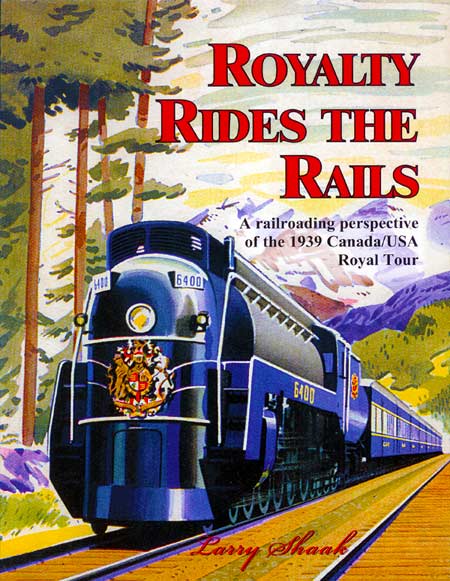
The Royal Train began its journey in Quebec City on May 18, traveling west through Montreal, Ottawa, Toronto and on to Winnipeg, Calgary and Banff before arriving in Vancouver on May 28.
The eastbound segment began May 31 and took Their Majesties through Jasper, Edmonton, Toronto and London where the train crossed into the US near Niagara Falls.
The Royal Train made a beeline for Washington, DC and a reception for the royal couple at the White House. Next came a day at the New York World's Fair and then a day with President Roosevelt at his retreat in Hyde Park.
From Hyde Park it was north back to Montreal and on to Fredericton and St. John before ending its journey June 15 in Halifax after 8,377 miles.
It was the calm before the storm. And Britain had made the most of it, strengthening transatlantic bonds that would last for decades...
If that doesn't make you want to snatch up this locomotive, I don't know what will...
If you want to read more about the 1939 Royal Train Click Here! If you still want to get this locomoitve, before you go off reading all about it, make sure to contact Hannah before you go, or you're sure to miss your chance!
The first Icon of Canadian Steam is the Canadian Pacific Royal Hudson, possibly the most famous Canadian steam locomotive of them all.
The sixty-five Hudsons of Canadian Pacific in classes H1c, H1d and H1e comprised the second largest fleet of 4-6-4 "Hudson" type locomotives, behind only the New York Central’s. These modern locomotives were built by Montreal Locomotive Works between 1937 and 1940. Their semi-streamlined appearance was notable with a smooth smokebox front, rounded front cab corners and sheetmetal fairings along each side walkway. The three classes all shared common 75” drivers, 22”x30” cylinders and 288 square foot fireboxes. Their standard tractive effort rating was 45,300 lbs., but many members of the group were equipped with boosters which added an additional 12,000 lbs. to this number when engaged.
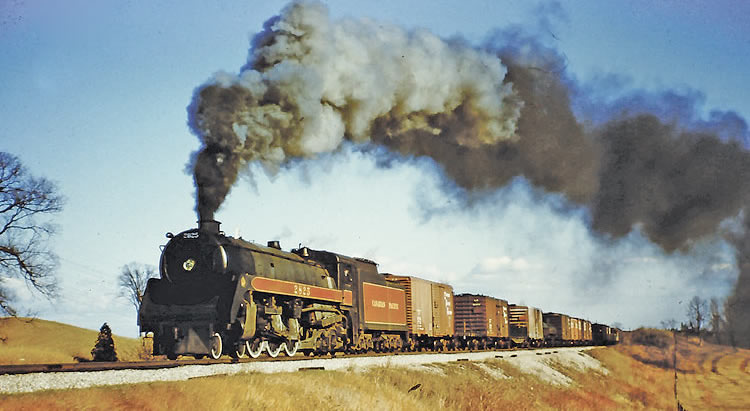
Although designed for passenger hauling, Royal Hudsons were equally at home on freight trains.
The Royal Hudsons could be found on the point of both passenger and freight trains across the CP system right up until the end of steam in 1960.
Rapido’s HO model of the iconic Royal Hudson will be the first in a series of steam locomotive models that incorporate the same attention to detail for which we have become renowned in our pervious releases.
The Royal Connection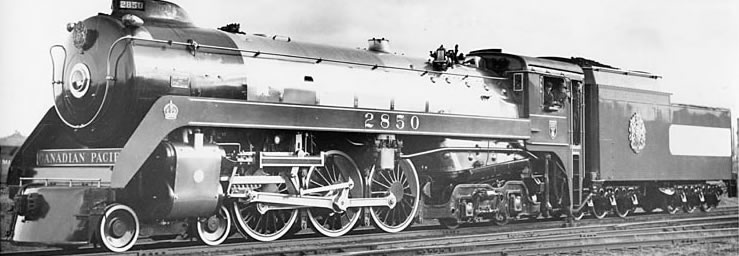
In 1939 King George VI and Queen Elizabeth embarked on a royal tour of Canada, travelling a great distance by rail. The CP assigned loco #2850 to the Royal Train. This locomotive was decorated in an exclusive scheme with silver boiler jacketing, blue running boards and cab and blue and silver panels on the tender. Large cast metal Royal coats of arms were applied to each side of the tender with a smaller version affixed to the top of the boiler front. After the Royal visit the CP asked and received permission for replica crowns to be applied to the running boards of all of the H1c-e Hudsons, earning them the moniker “Royal Hudson”.
Model Features
• Designed from blueprints and field measurements
• Factory-applied details specific for each road number
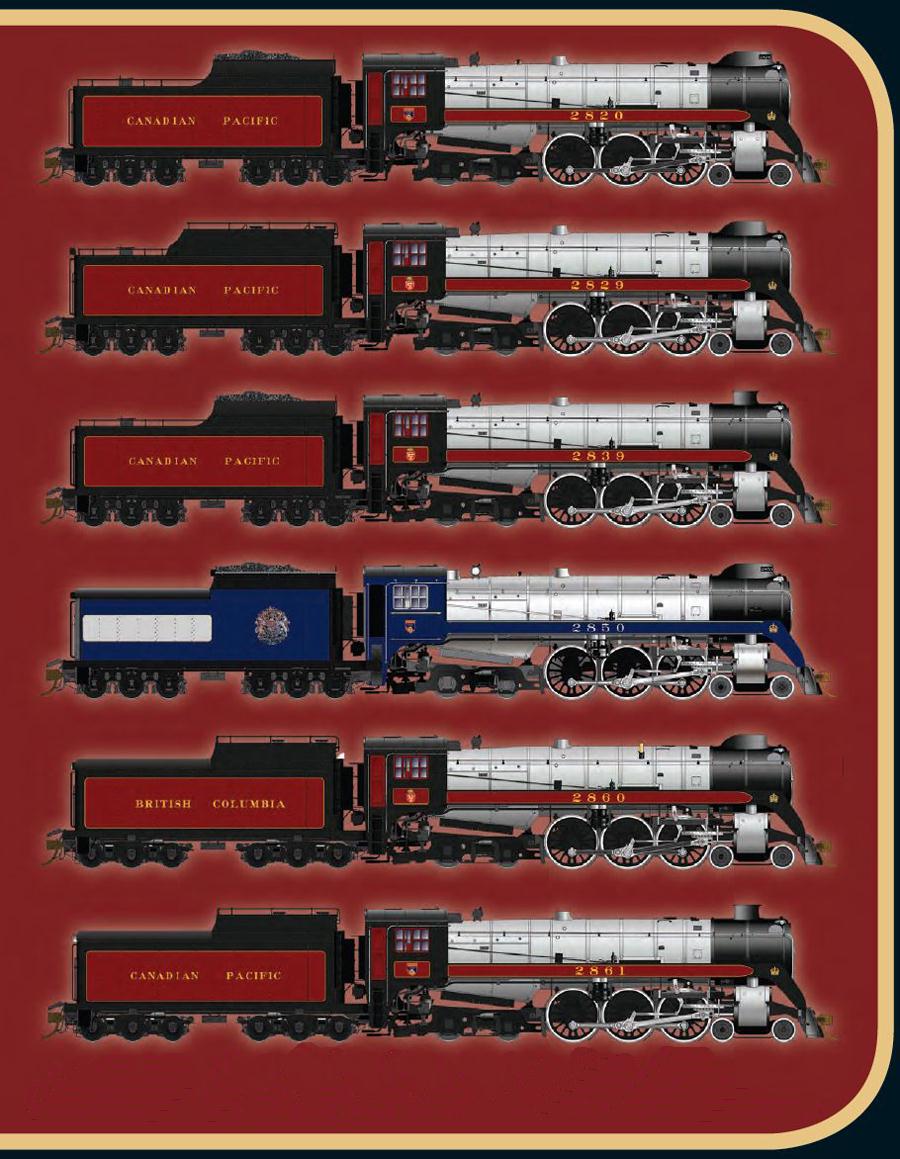
• Three stack styles – streamlined, straight or bathtub
• One stack installed but both others included in the box for modelling specific years
• Additional optional parts included in the box
• Smooth-running drive with strong pulling power
• Heavy diecast weight centred above drivers
• Blackened metal wheels and driving rods
• Correct tenders for either coal, oil, or oil-fired conversions
• Correct tender trucks (Commonwealth or Buckeye)
• Working head, marker, classification and back up lights*
• Interior cab light, flickering firebox light*
• DCC sound version includes synchronized chuff, accurate whistle, bell air, pump, generator, safety valves and many other effects!**
• Accurate and complete piping, underbody and tender details
• Accurate paint and decoration
• Beaver logo printed on the cab side with "Spans the World" decal included in the box
• Unnumbered locomotives include all possible number decals
• 18” Minimum radius (22" recommended)
* Not all lighting effects available on Silent versions.
** User-controlled sound features only accessible on DCC layouts.Photos courtesy John Riddell.

 © 2026 Pacific Western Rail Systems
Train Addiction Help Line: 1 866 840 7777
© 2026 Pacific Western Rail Systems
Train Addiction Help Line: 1 866 840 7777