Train Addiction Help Line: 1.866.840.7777
Mar 12, 2021 - N Scale
Kato (Japan) - N Scale - March 2021 Releases


Kato (Japan) has announced new March 2021 Releases
C57 First Generation Steam Locomotive
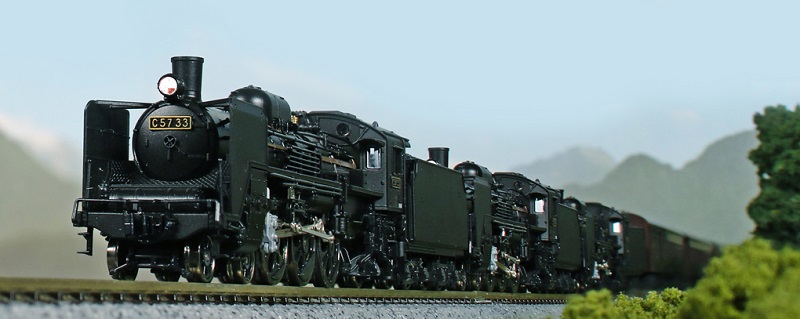
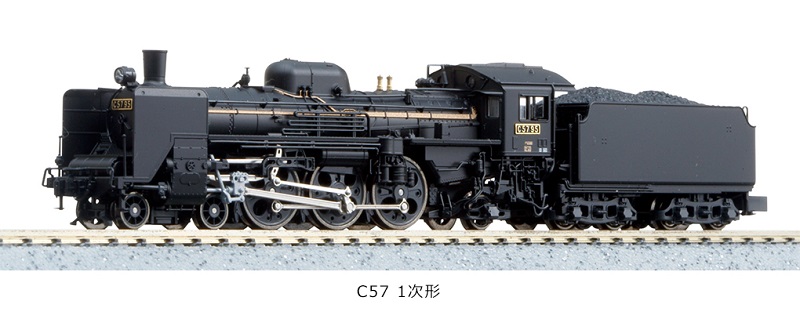
JNR’s steam locomotive C57 is a model which was made based on the design of C55 by improving the function of boiler. As many as 201 cars were manufactured from 1937 to 1947 to pull express trains, etc. on main lines and sub-main lines across Japan. The locomotive was known under nickname “Noble Lady” and it was liked so much that many of the locomotive are still preserved in museums or operated as event trains. 12 cars of C57 4th model Nos. 190 through 201 belong to the final group produced from 1946. This model is changed in terms of the outlook in that it has a bit thicker boiler, corner-cut smoke deflectors, cab with doors and tender with round bottom and trucks with roller bearing wheels. In the last age of steam locomotives, this model was deployed to Miyazaki engine zone, etc. and became the last locomotive to pull the express train “Nichinan No. 3” until it was taken out of service in 1974. The express used to depart from Kyoto and travel nearly 1,000 km on Sanyo line in Japan Proper and on Nippon Main line in Kyushu Island southward to Oita, Miyazaki and Miyakonojo. The last steam locomotive CT270 which has ever pulled passenger trains in Taiwan is the same model as C57. 6 cars of CT270 were manufactured by Kawasaki and Hitachi in 1942 and 1943 before the war and 8 cars were additionally manufactured by Hitachi under assistance from U.S.A. so that total of 14 cars were operated till the electrification.
It is a locomotive which is suitable for any scene with a steam locomotive train. When it was still in active service, it pulled not only a freight train but also a long passenger train as an express or as a local train. So you can make a various kinds of scale model train consist. It is also fun to reproduce in N scale such triple locomotive heading, as seen before on Bantan line, to deadhead locomotives.
Features:
● C57 began to produce from 1937 as a secondary level passenger traction machine for main transport line, and 201 locomotives were produced in total. It is very popular due to its sleek and highly complete appearance, and is nicknamed "Lady" because of its elegant impression.
◆ The power unit equipped with a coreless motor that has a good reputation for running. This product is mounting flywheel which makes it smooth and stable running.
◆ An optional Assy part sale separately for C12 snowplow can be attached.
EF58 Late Type Big Window Blue Electric Locomotive

- Reproduce the front of the original large window equipped with a drainer
- Accurately reproduce the original side filter
- Accurately reproduce equipment such as fusee and lightning arrester on the roof
・Representing the driver's cab (operation panel, chair, indoor see-through)
- Beautiful reproduction of body notation
・Headlight lighting
・Powerful and smooth running performance is demonstrated by adopting a power unit equipped with a flywheel.
- Arnold coupler standard equipment. Replacement knuckle coupler included
・Selectable license plates "31" "53" "61" "66" "69"
・Accessories: Selectable license plates, nigiri sticks, whistles, replacement knuckle couplers, roof equipment
Series 100 “Grand Hikari” 6-Car Basic Passenger Set
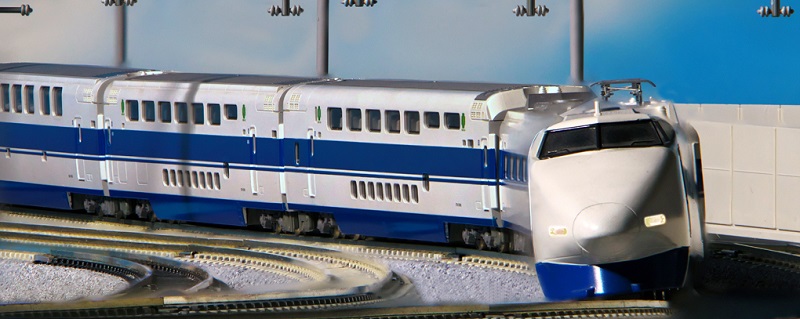

● The 100 Shinkansen is the second generation vehicle of the Tokaido / Sanyo Shinkansen. It appeared in 1985 during the JNR era. Unlike the rounded appearance of the original 0 series, the leading part called the shark nose has become sharper. It was active in the Tokaido / Sanyo Shinkansen.
In 1989, the 3000 series with 4 double-decker cars (previously 2 cars) was added to operating as “Grand Hikari”of JR West. From the capital letter V of the formation number, it was called "V Hikari" and was familiar to many people.
◆ The add-on set is changed from 2-car set to be a 4-car set.
The car number and marks of each car are printed, so you can enjoy the full formation more easily.Other specifications are unchanged from the previous product.
Composition of Trains

Features:
- The 100 Series Shinkansen, which was very popular as the 2nd generation Shinkansen. Reproduce the dynamic V formation with 4 double-deckers built-in
・You can easily start with a 6-car train and get a popular car that you can enjoy by extending the train by buying more!
・By combining the basic set with a 6-car add-on set and a 4-car add-on set, it is possible to reproduce the 16-car formation just like the actual car.
・The 4-car add-on set has the car numbers, car numbers, etc. of cars 3, 4, 12, and 13 printed on it.
- Reproduce the realistic roof shape with the removed pantograph trace and the attached roof insulator as in the actual vehicle
- The KATO diaphragm coupler reproduces the realistic connection surface spacing, and accurately expresses the Shinkansen wheels equipped with disc brakes.
・Light bulb color LED head / tail light lit
・Accessories ・ ・ ・ Insulators, destination display stickers
“Series 0 Shinkansen” Sound Card
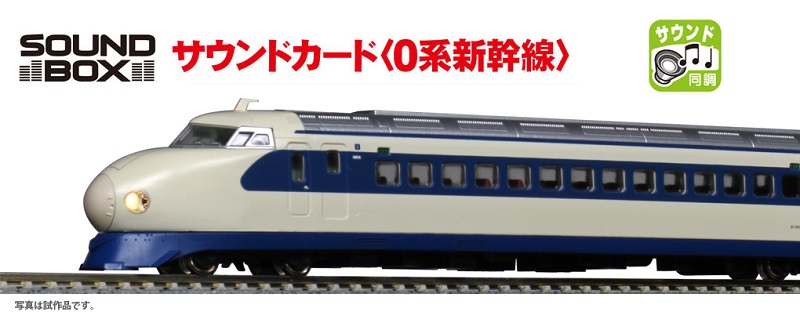
● This product is a "sound tuning" type sound card equipped with a "controller priority mode" writing function.
In addition to enjoying vehicle driving with a realistic feeling of acceleration and deceleration that is synchronized with the running sound, sound driving that is easy to drive is also realized that is synchronized with the operation of the power pack. Even those who start driving with a sound box can easily enjoy it.
- The sound card of the 0 series Shinkansen, which was familiar to many people as the first historic Shinkansen, has appeared.
・Running noise, air conditioning, compressor operation noise, brake squeal, etc. are automatically played depending on the situation, and you can also enjoy the environmental noise of the station platform.
- The melody / chime in the car reproduces the 0 series sound from the opening of the Shinkansen to the retirement of the Tokaido Shinkansen.
→ In-car melody: "Railway song" "0 series Shinkansen in-car melody", in-car chime: "Hikari chime for first and last stations" and "for midway stations"
- The running noise reproduces the noise generated from the main circuit under the floor during acceleration, the squeaking noise of the car body, and the passing noise of the former weld (welded part between rails) when driving at high speed.
・The sound of the station departure bell and signal buzzer, the sound of passing through a turnout, etc. will produce a scene unique to the Shinkansen.
- Sound-tuned type cards can be enjoyed as if you were driving an actual vehicle by accelerating / decelerating according to the running sound.
- In controller priority mode, the vehicle runs according to the operation of the power pack, similar to the controller tuning type sound card. You can easily enjoy it even for those who are starting a sound card from now on.
A "function label" compatible with the sound box is included in the package.
NAHA 11 Passenger Car
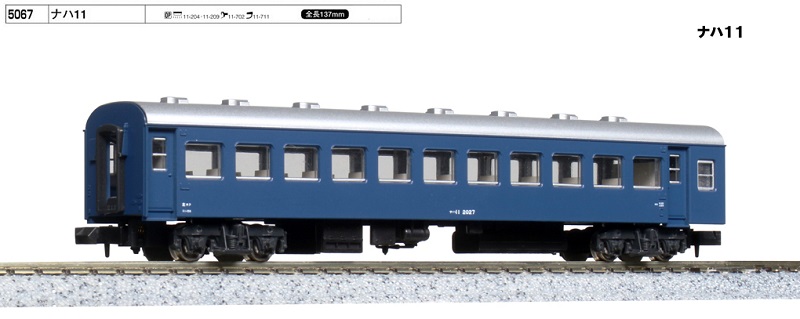
Passenger cars after Naha 10 that appeared in the 30's of the Showa era were different from the passenger cars up to that point. The biggest feature of these passenger cars, called "lightweight passenger cars," is that they have been thoroughly reduced in weight with the aim of increasing transportation capacity and speed. It is 30% lighter than the Suha 43 series, and all subsequent passenger cars have become "lightweight passenger cars."
Composition of Trains

Features:
● For brake vans, the tail light is lit by LED (only on one side)
● WC / washroom window expressed with milky frosted glass
● Delicate expression of sash and H rubber
- Detailed reproduction of the bed seen from the window
- Detailed reproduction of lettering of each part of the car body, including markings such as "A sleeper" which is a feature of 10 series sleeper
● TR50 type and TR53 type dolly with three-dimensional and heavy details
- Modeling the difference in body length of each car according to the scale
● Underfloor equipment that reproduces air pipes and brake levers
● Naha 11, Nahafu 11
・Nahafu 11 has a tail light on (with a light-off switch)
・Accurately express the milky white glass of WC / washroom windows
・Delicate expression of sash and H rubber
- Detailed reproduction of lettering of each part of the car body
- Reproduce the TR50 type dolly with three-dimensional and heavy details
- Reproduce the underfloor air pipe and brake lever
・Accessories (Nahafu 11) ・ ・ ・ Driver for turn-off switch
● Suhane 16: Ordinary sleeping car. A vehicle with a cooling device attached to Ohane 17, which is a new body similar to a lightweight passenger car on the underframe of an old passenger car.
● Ohane 12: An ordinary sleeping car with three levels of sleepers lined up on a wide body in the direction perpendicular to the railroad tracks. The aisle side and the sleeper side show different facial expressions. Coolers line up on the roof
● Ohanefu 12: A vehicle with a conductor room on Ohane 12
● Orone 10: Sleeping car. It features a fixed window with air conditioning, a deep roof, and a small window for the upper sleeper.
● Slot 62: Green car. It is a "steel passenger car" made from a wooden passenger car. AU13 type cooler is equipped with turtle child type
● Osh 17: Dining car. With air-conditioning and fixed windows (dining room), the width of the car body has been expanded, and the capacity for 4 people is 40 people.
● Oro 11: Naro 10 type air-conditioning construction vehicle. Used for express "Sakurajima / Takachiho" and "Nichinan"
● Oyu 12: Convoy post office (a type of post office dedicated to transportation that does not sort in the car). Conductor room side: With light-off switch
SUHA32 Passenger Car
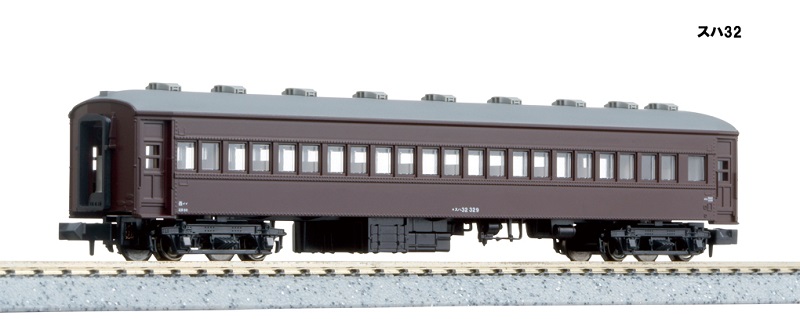
Kato will make in N scale model of series SUHA 32 coaches which represent prewar steel passenger car models. These are 20 meter-class steel coaches which appeared from 1927 to 1942. They are made of steel and took over the body dimensions and the truck structure from the conventional wood coaches.
Using #2024 Steam Locomotive C57 1st planned for simultaneous release, you can reproduce the triple heading by C57 drawing a local passenger train as seen in 1960s on Bantan LIne.
Features:
● The elegant air unique to SUHA32 with narrow windows in a row reproduced
● Nostalgic brown color on the old passenger cars accurately representedSUHA33 furnished with TR40 Trucks
● SUHAFU32 installed with the ladder on the side of braking chamber
● SUHAFU32 with the taillights on (with turn-off switch) on teh side of braking chamber
OHANI Passenger Car
The Oha 35 series is one of the representative passenger car types of the prewar Japanese National Railways, and has mass-produced more than 2,000 cars, which is the largest number of passenger cars in Japan. Introduced in 1939 with a folding wife / dome, a 1-meter-wide cabin window, a TR23 dolly, and a structure that makes heavy use of welding. Production before the war was discontinued in 1942, but when production was resumed after the war, it could be classified as a post-war type due to circumstances such as difficulty in obtaining materials and evolution of construction methods. Appeared in a unique form. Its characteristic is that the round roof is straightened (initially narrowed down) as it is a folded wife, and it has a form located between the general type Oha 35 series and the gable Suha 43 series that will appear later. As for the bogie, TR34 type, which is an improvement of TR23 type of flat bearing to domestic roller bearing, is adopted from the middle. Operationally, it was used in exactly the same way as the general type Oha 35 series, so its range of activity extended to all lines nationwide, and its activity could be seen everywhere from express trains to ordinary trains. The Ohani 36 series is based on the steel body passenger car Ohani 63 series that appeared in 1955, and is structurally a vehicle belonging to his Oha 61 series manufactured for local lines. However, since it was designed from the beginning for use in honor trains, the guest rooms are compliant with the Suha 43 series for express trains. Since the TR11 type dolly that was originally equipped is not suitable for high-speed driving, it was transferred to the TR52 type dolly from 1956, and it became the Ohani 36 type. The range of activity is wide, and we were able to see the activity on all lines nationwide, from express trains to ordinary trains.
● Oha 35 series general type
- Faithfully reproduce the solid style that uses a lot of rivets, which seems to be an old passenger car
- Beautifully reproduces the standard paint color of the old general-purpose passenger car of the Japanese National Railways, which is now a nostalgic coloring.
- Brown is the image of the original vehicle and has a wooden door. Blue adopts the shape of a metal door with H rubber in the image of an updated vehicle.
・Brake vans (Ohafu 33, Suhani 32, Ohani 36) are equipped with a lighting taillight as standard equipment (with a light-off switch).
- Suhani 32 and Ohani 36 faithfully reproduce the medium-sized loading doors and luggage compartment window grids (protective rods) peculiar to passenger cars.
・All vehicles Arnold coupler standard equipment
● Oha 35 series postwar form
- Faithfully reproduce the characteristics of the Oha 35 series post-war model with a wife board described as "mushroom, bread".
- Beautifully reproduces the standard paint color of the old general-purpose passenger car of the Japanese National Railways, which is now a nostalgic coloring.
- Brown is the image of the original vehicle and has a wooden door. Blue adopts the shape of a metal door with H rubber in the image of an updated vehicle.
- The TR23 trolley (roller bearing) is realistically reproduced in the Oha 35 post-war model.
- A TR34 dolly is used for the Ohafu 33 post-war model.
・Brake van (Ohafu 33) is equipped with a lit taillight as standard equipment.
・Single item
・ Tail light on (with off switch) Ohafu 33 only
・ Accessories Driver for switching off switch
・ All vehicles Arnold coupler standard equipment
Optional options
● Clear LED interior light Part number: 11-221 ¥ 792
● LED interior light clear (6 cars included) Part number: 11-212 ¥ 3,960
● LED interior light clear (bulb color) Part number: 11-213 ¥ 792
● LED interior light clear (bulb color) (6 cars included) Part number: 11-214 ¥ 3,960
● KATO Coupler N (PAT.) Part No .: 11-702 ¥ 440
● Magnetic Coupler MT-10 Part No .: 11-711 ¥ 440
● KATO Coupler N (Black) Arnold Coupler Installed Vehicle Part No .: 11-702
● KATO Coupler N JP A Arnold Coupler Installed Vehicle Part No .: 11-721
● Spoke wheels for old passenger cars (axle length) Part number: 11-609
SEIBU Railway 40000 Series Basic Passenger Set (4 Cars)
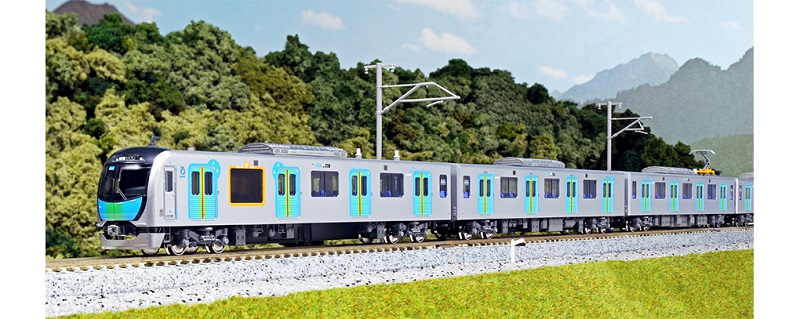
Seibu Railways Series 40000 is a new commuter train to be put in service in 2017 spring. It is characterized with light color scheme which symbolizes landscape and nature along the truck.
The train to be completed this year is a train whose seats layout is convertible between vertical long seats and those in horizontal rows furnished with a toilet in coach No. 4 which will be used as a reserved seats car. The train is planned to be used in the joint operation to run on to a subway line directly.
Please have fun by running it together with Seibu Railways other trains or with trains of other railway companies, with which Seibu runs joint operation, such as Tokyo metro Series 10000 or Tokyu 5050-4000.
Composition of Trains

Features:
● The prototype for scale model is a train with seats convertible between vertical long seats and those in horizon rows.
● Gently curving front head sleek aluminum body form colorful paint scheme are accurately reproduced.
● The scale model is made with seats laid out in horizontal rows.
● Destination display of “S-TRAIN Seibu Chichibu” is printed on the front and sides. “S-TRAIN Motomachi/Chukagai (China Town)” is also included for replacement.
● The destination display for the 10-Car Set remains blank so its sticker included in the product can be applied to. The destination is printed on the add-on set.
● Head/taillights and front lights operative using white LED
● Equipped with GM-3 motor and Kato tight coupler. DCC friendly
KOKI107 Non-Container 2-Car Set

These are new series container cars which match currently operated lotomotives such as DC Electric Locomotives EF200、EF210、EH200 and AC/DC Electric Electric locomotives EF510、EH500 s well as JNR models EF65、EF81.
KOKI 107 is a general-use container car improved from KOKI 106. It has modified braking apparatus into a braking system unit and is characterized with a hand brake installed in deck handrail. The base frame is painted gray like KOKI 106.
KOKI 107 is mainly used for high speed rail cargo. With the train weighing 1,300 kgs (26 car train), it operates at the maximum speed of 100 kms per hour. With the train weighing 1,200 kgs (24 car train) or less, it operates at the maximum speed of 110 kms per hour. It is deployed widely across Japan, to Tokaido/Sanyo Mainlines as well as to Tohoku Mainline. to Hokkaido Line and to the Lines on Japan Sea.
Composition of Trains

Features:
● KOKI 107 471 included in KOKI 106+107 without container 10 Car Set have operative taillights representing the lights at the last end of train.
● The scale model reproduces accurately the framing form which allows the base frame to be removed and shows complex piping. Even if no container is loaded on it it allows the appreciation of precise details just like the prototype.
● KOKI 107 reproduces such charateristics as the base frame which is different from KOKI 106 in the shape hand brake which position is moved from the side to the deck handrail.
● The letterings are reaslisticallyreproduced.
● Hand brake handle is reproduced in yellow color just like the real car. The hand brake will be a part for the consumer to install.
● Container stopper will be reproduced on the upper side of base frame.
● Equipped with Arnold couplers.2 Car Set will include the reflector to be installed on the end of train.
● The inner packaging cushion stores a container car with or without container. The inner package in the bookcase type can contain 12 cars of KOKI104/106/107.
Looking for more Kato (Japan) N Scale Train Sets? Click here!
Order Due Date: March 25, 2021
Anticipated Delivery Date: September 2021
Looking for more Kato (Japan) N Scale items? Click here!

Product Details




 © 2026 Pacific Western Rail Systems
Train Addiction Help Line: 1 866 840 7777
© 2026 Pacific Western Rail Systems
Train Addiction Help Line: 1 866 840 7777