Train Addiction Help Line: 1.866.840.7777
Apr 27, 2016 - HO Scale
ORDER DEADLINE ALERT - Atlas Master HO Scale GE U33B 7 U36B Locos
You must place an order for any of these products NOW if you want
GUARANTEED DELIVERY
The horsepower race was in full swing by the late 1960s when GE introduced the 3,300hp, four-xle U33B locomotive. 137 units were produced between September 1967 and August 1970 when roduction ended. GE upped the horsepower ante in 1970 with the introduction of the 3,600hp 36B which was produced between May 1970 and December 1974. Both models were externally dentical, and internally they were both powered by the same GE FDL-16 cylinder four-stroke ngine. The horsepower increase was achieved through adjustments to the fuel rack settings and ther internal component changes. One key spotting feature of both models was the built-out adiator “wings” on the long hood.
Atlas’ U33B and U36B model is being offered in both an early and late phase. The early phase odel includes flushmounted radiator screens and air intake screens on the long hood. In addition, here is a built-out area on the top of the front and rear pilots. Late phase models include corrugated adiator and air intake screens, with a flat pilot face. An optional separate electrical equipment boxs included on the left side walkway behind the cab per the prototype. AAR-B or Blomberg trucks are sed when appropriate.
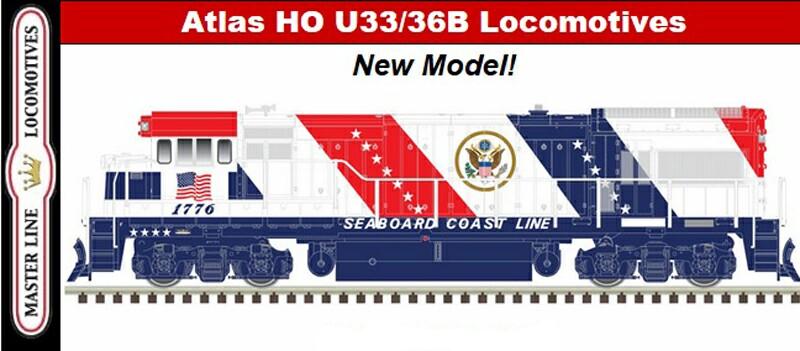
Seaboard Coast Line 1776 - SCL 1776 was the nation’s first Bicentennial unit, being built in June 971. It was actually the second SCL U36B numbered 1776. The first was delivered in standard black and yellow paint. When later production unit 1803 was chosen to receive the special ommemorative scheme, the original 1776 was renumbered as 1813. The “new” 1776 went on to be one of the more famous bicentennial models, and it started the trend of railroads large and small epainting units in honor of the nation’s 200th birthday celebration in 1976.
Reservations Due By: May 3, 2016
Expected Release: October 2016

reb
Product Details


 © 2026 Pacific Western Rail Systems
Train Addiction Help Line: 1 866 840 7777
© 2026 Pacific Western Rail Systems
Train Addiction Help Line: 1 866 840 7777