Train Addiction Help Line: 1.866.840.7777
Mar 7, 2016 - HO Scale
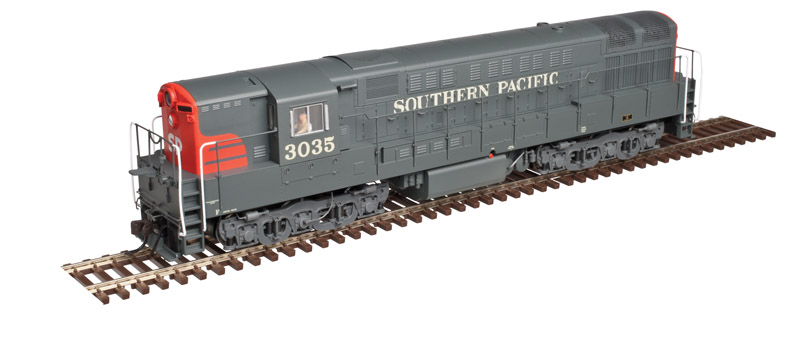
ORDER DEADLINE ALERT - Atlas HO Scale H24-66 FM Train Master Locomotives
You must place an order for any of these products NOW if you want
GUARANTEED DELIVERY



New Road Numbers & Paint Schemes!
Advertised by Fairbanks-Morse as "the most useful locomotive ever built", the H24-66 Train Master was first introduced in 1953. Designed as a versatile locomotive with various equipment
options available, it was found in both passenger and freight service across the US. It was the most powerful single-engine locomotive in production at the time, generating a total of 2,400 hp.
Features:
Separately-applied door handles
Real metal springs on trucks
Realistic die-cast underframe
Five-pole skewed armature motor with dual-flywheels for optimum performance at all speeds
Directional lighting
Factory-equipped with AccuMate® couplers
Painted crew figures
Separately-installed fine scale handrails
Etched metal radiator grilles
Electronic Dual-Mode Decoder (e-DMD) (Gold Series only) that allows your locomotive to run in DCC or DC
NMRA 8-pin plug for DCC (Silver Series only)
Railroad specific details (Lighted classification lights on some models)
Sound Features for Gold Series :
(DCC Operation)
Supports all DCC-programming modes
Flexible mapping of function keys F0 to F28.
A total of six DCC function outputs are available
Follows all NMRA DCC standards and recommended practices.
Analog (DC) Operation:
The LokSound Select Dual-Mode decoder allows your Atlas Gold Series locomotive to be used on DC as well as on DCC layouts.
• Please note that the Atlas Quantum Engineer will NOT operate an Atlas Gold Series locomotive equipped with a LokSound Select decoder on an analog (DC) layout. However, the sound and
lighting
functions of the LokSound Select decoder in the Atlas Gold Series U23B locomotive can be controlled by an easy-to-use basic DCC system.
Also note that on a DC-powered layout, a DCC and sound equipped locomotive (such as the Atlas Gold Series Train Master) CANNOT be consisted with another locomotive that does not also
have both DCC and sound. (This statement does NOT apply to DCC-equipped locomotives operating on a DCC layout.)
Sound Functionality:
Over 20 sound effects are available, including engine start-up and shutdown, prime mover sounds through all eight notches, bell, air horn, air compressor, dynamic brakes and more.
There are 16 user-selectable horns, 2 user-selectable bells, and 2 user-selectable synchronized brake squeals.
Manual and Automatic Notching modes with the ability to change modes ”on the fly” are provided for true realism.
Reservations Due By: March 8, 2016
Expected Release: October 2016

REB
 |
Atlas HO DASH 8-40C/CW Locomotives | ||||||||||
New Road Numbers & Paint Schemes!
(Click thumbnail to enlarge)
|
|||||||||||
|
First built for Union Pacific in the late 1980's by General Electric, the DASH 8-40C diesel locomotives were identified by an enlarged exhaust stack and the mounting of the dynamic brake grids in a square-like unit behind the cab, which housed an enlarged equipment blower fan. These six-axle, 4,000 hp engines are still in service today in North America. The 4,000hp Dash 8-40CW was produced by General Electric between 1989 and 1993 as a follow-up to the successful Dash 8-40C locomotive. The most distinguishing feature of this model was the introduction of GE’s version of the wide-nose “North American Safety Cab.” This style of cab would become a common sight on railroads across the country. Four major railroads purchased the Dash 8-40CW in fairly large quantities, including Conrail, CSX, Santa Fe and Union Pacific. Most of these units are still in regular mainline and heavy-haul freight service today. Due to various mergers, they can also be seen operating for new owners Norfolk Southern and BNSF. |
|||||||||||


Product Details


 © 2026 Pacific Western Rail Systems
Train Addiction Help Line: 1 866 840 7777
© 2026 Pacific Western Rail Systems
Train Addiction Help Line: 1 866 840 7777